Dutch appeltaart (work in progress)

There have been a few ventures out into the damp November countryside this week. Thinking ahead, I’ve caught my Christmas goose early to take advantage of early-bird (excuse the pun) prices. Mrs Goodman breeds the best free-range Christmas poultry, and if you collect direct from her Great Witley farm then you save ££. I forget how glorious the countryside is around this part of Worcestershire; even on a dim, damp late-autumn morning it was beautiful.

Fields in Great Witley on a damp November morning

Goodman’s Geese, home of the best Christmas poultry

This year’s goose is a little larger than anticipated…

Then Saturday took us to Baddesley Clinton, for some lunch and fresh air after a photoshoot in Coventry. The National Trust have reconfigured the vegetable garden there and I now have envy for straight edging, compacted gravel paths and lean-to greenhouses.

Matt inspects the glass house at Baddesley Clinton

To today’s recipe. I’ve only been to the Netherlands twice, but both times I’ve been blown away by the brilliance of appeltaart, or Dutch apple pie. This one I had at Amsterdam’s Rijks Museum – I know I should be more interested in the art at this great establishment but pffff, baking wins every time. Appeltaart is a deep dish apple pie with a buttery biscuit-like crust, filled with apple slices or chunks that cook together with sugar and spice to make a creamy-yet-textured filling. Appeltaart is always served in generous wedges, cold or at room temperature, with a dollop of whipped cream (slagroom, in Dutch). It’s earth shatteringly good and a thing of beauty.
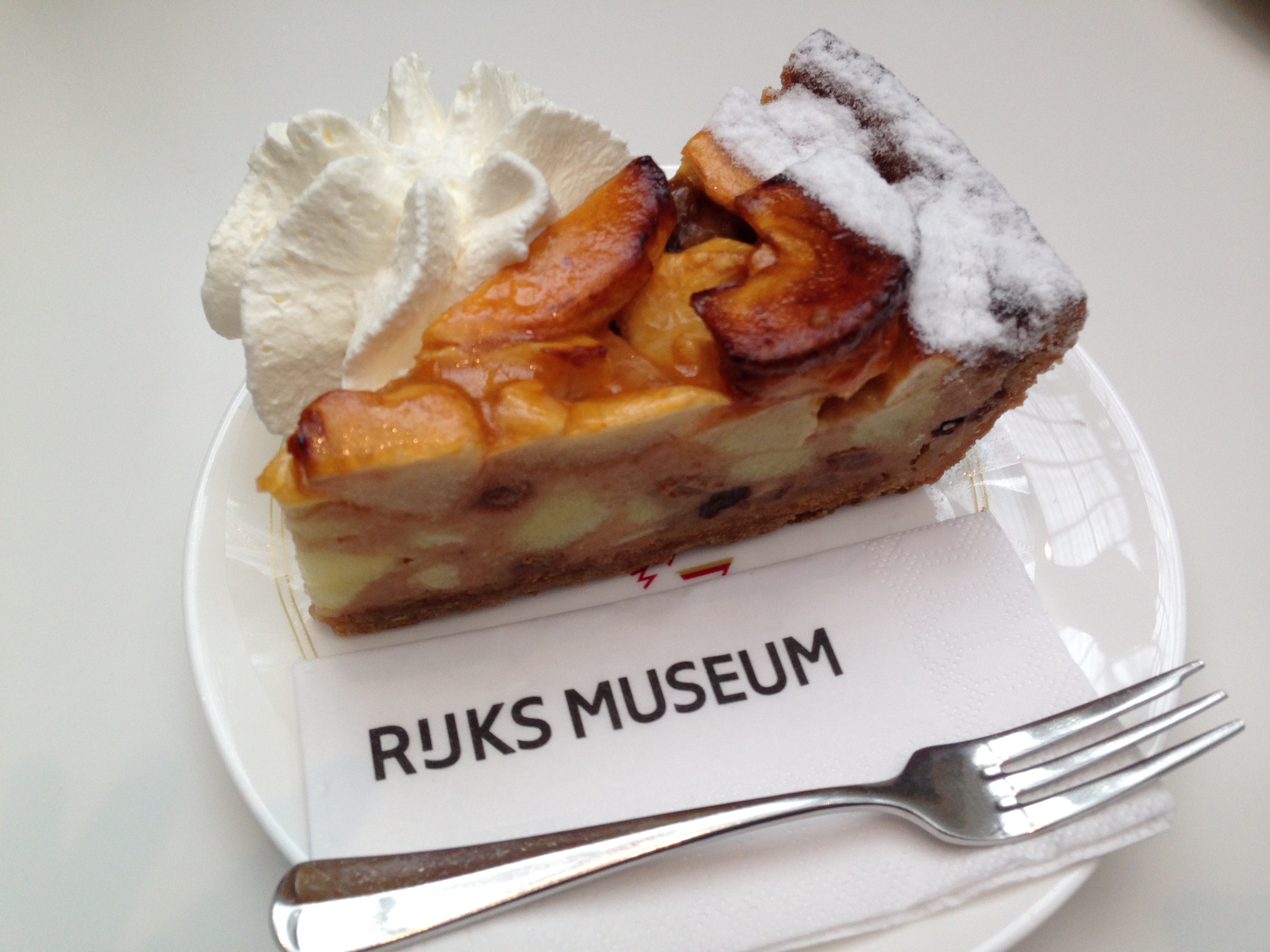
The best apple pie, at Amsterdam’s Rijks Museum

I have wanted to have a go at making one for some time, but felt daunted at the challenge. All the recipes that I could find are either in Dutch (my languages aren’t great) or American, which requires translation from their mad cups measurement system into grams or ounces. Plus any baking this beautiful MUST be really hard…there was the certainty that I’d mess it up somehow. Then I found this brilliant blog post by a Canadian food writer with a step-by-step method to making appeltaart and I thought actually, perhaps I need to woman up and give it a go. I have translated Food Nouveu’s cup measurements into grams, and also reduced the quantity as I could not face eating apple pie for the next two months. The resulting recipe is good but still needs tweaking – let’s call it a work in progress.

Appeltaart is made with a crust that you press into the tin with your fingers, which is actually loads easier than rolling out shortcrust. In a food processor, pulse together butter, brown sugar, salt, eggs and flour until the mixture looks like play dough, then leave it to firm up in the fridge for half an hour or so.

Pulse the pastry ingredients in the food processor until they look like play dough

Then press the dough into your pie dish with your fingers. You need to make it even all the way around – it may help to wet your fingers so that they don’t stick to the dough. I used a pie dish with a removable base but a spring-form cake-tin would also work well.
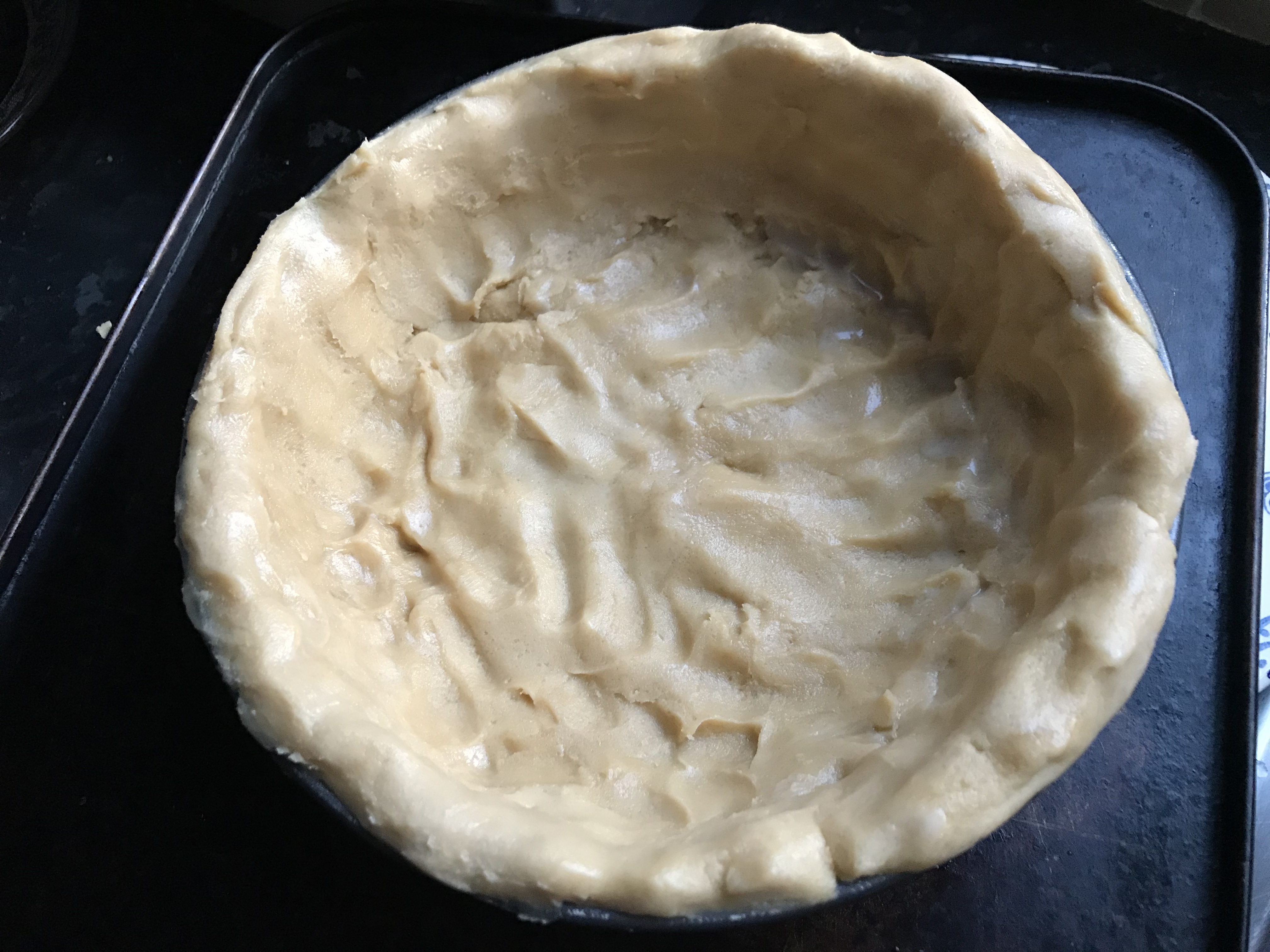
Press the dough into a loose-bottomed pie dish with your fingers, trying to keep the crust even (more even than I did)

The filling is simple enough. Apples, obviously. You need to choose your fruit wisely, with a mixture of acidic cookers and firm eaters so that when they cook you get both softness and  texture. I used a mixture of bramleys and anonymous eating apples. Chop or slice them up and mix with orange zest, lemon zest, lemon juice, brown sugar, mixed spice (or cinnamon and ginger), cornflour, raisins and a slug of brandy.

Chop apples and mix with the citrus zest, juice, cornflour, sugar and spices

Pile the fruit into your crust evenly, then top with any remaining dough. I made my crust too thick so had very little dough left to make a topping, but if you have more you could make a lattice or even a full pie-top.
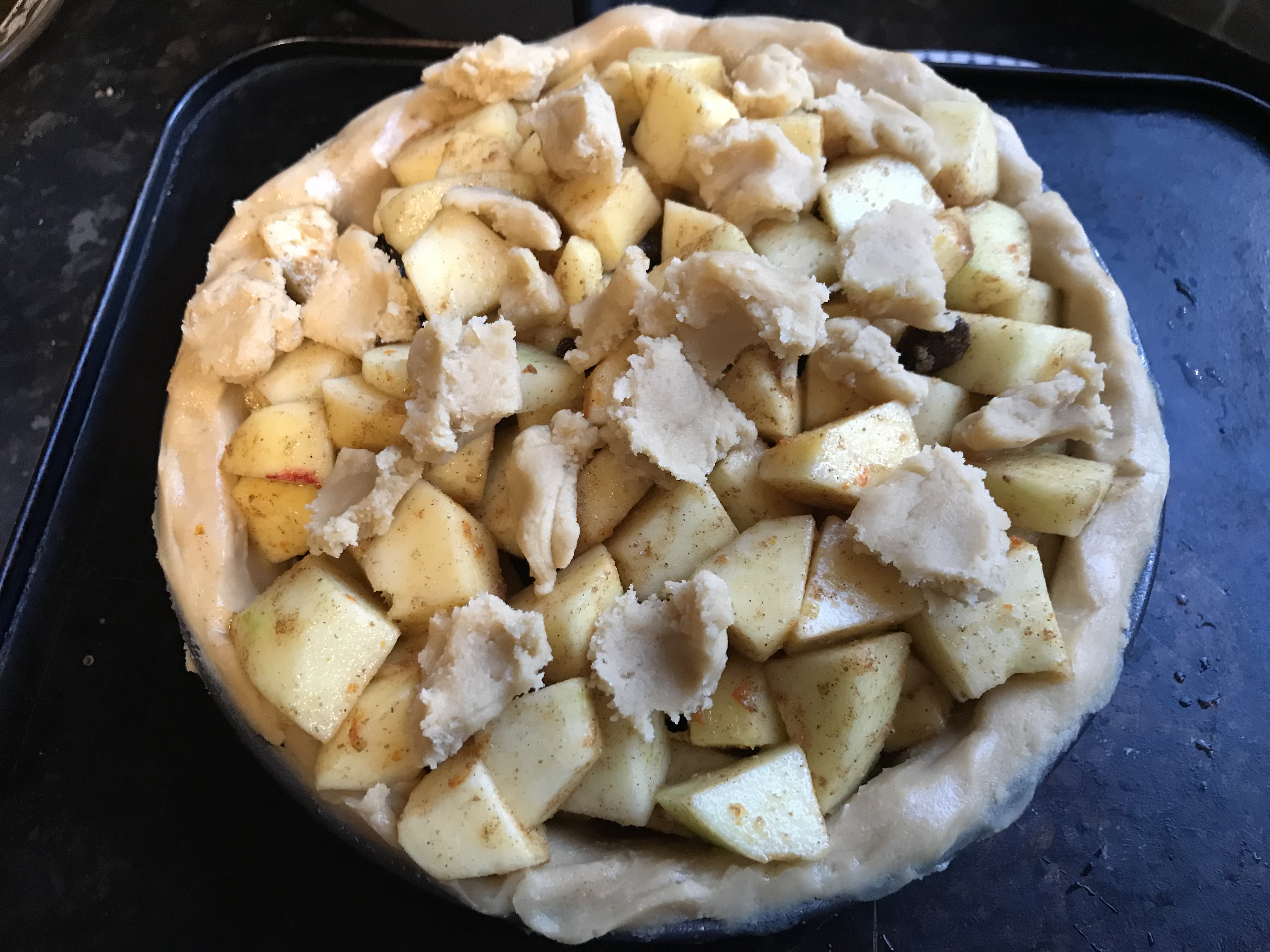
Pile the apples into the dish and dot with any remaining pastry, then bake

The appeltaart is baked for what feels like an eternity (about 1 1/4 hours) and then left to cool completely before serving with whipped cream. I kept forgetting to photograph the final result, hence this awful picture of the final slice of tart! The flavours were great but the execution needs work – I think I need a pie dish with a smaller diameter to make for a deeper pie, then I can go thinner on the crust. I might also be tempted to slice rather than dice the apples, so they cook more evenly. But that aside: this is a great apple pie and a useful recipe to have up one’s sleeve for when a trip to Amsterdam is impossible.

Mine is nowhere near as beautiful as the Rijks Museum version, but a valiant first effort

Appeltaart (work in progress)
Adapted from the Food Nouveu blog

Note: Allow several hours of cooling time before you can dish up your cooked pie. You need a 6 or 7inch springform tin or one with a removable bottom. (If you go larger you will need to increase the quantity of pastry and filling.)

For the pastry:
170g unsalted butter
20g light soft brown sugar
1 egg, beaten
280g plain flour
pinch of salt

For the filling:
1 large or 2 small bramley apples
4 small or 3 large eating apples
zest of half an orange
zest of half a lemon
juice of half a lemon
25g brown sugar
1 level teaspoon mixed spice, or use a mixture of cinnamon and ground ginger
1 tsp cornflour
1 tblsp brandy or apple juice
Small handful of raisins

First make the crust. In a food processor, pulse the butter and sugar until creamy. Add the egg and the flour in batches, scraping down the sides to make sure everything is combined. Add the salt and pulse again. The dough will first come together in a scraggy way but eventually becomes smooth and firm, like play dough. Transfer to a bowl and chill whilst you make your filling.

Make the filling: Slice or dice the apples and mix together with the citrus zest, juice, sugar, spice, cornflour, brandy and raisins.

Make the pie: Pre-heat the oven to 190c. Grease your tin well (you can choose to line the base with baking parchment if you prefer). Press about half of the crust mixture into the base of the tin, keeping it as even as possible. It may help to dampen your fingers for this. Then take lumps of the remaining dough to line the edges of the tin, ensuring there are no gaps or holes anywhere. Pile the apples into the dish, then dot any remaining crust mixture onto the apple surface.

Place the tin onto a baking sheet to catch any juices that leak out, then bake at 190c for 30 minutes. Turn the oven down to 170c and continue to bake until the apples are soft and the crust is crisp – about 1 1/4 hours cooking in total but it may be longer. You may need to cover the tart with foil to prevent the pastry from burning.

Cool for several hours before slicing – you can turn it out onto a wire rack but I kept mine in the tin. Serve in generous wedges with whipped cream. Keep any leftovers in the fridge.

First frosts and whiskey cake

Our house needs a big red cross on the front door: once again we are diseased. Well actually it’s not that dramatic – potentially a bit of hand, foot and mouth, except Harry’s spots are on his bum, knees and mouth. I haven’t googled “bum, knees and mouth childhood illness” as I’m pretty certain it’s new to science. Whilst Harry’s potentially infectious and therefore off nursery, I’ve been mentally bouncing off the walls at being nearly-housebound. The worst is over so today we even went to Ikea out of desperation.

In the meantime, autumn has taken hold and Birmingham is bathed in golden colour. It’s good to pay attention to these things…the changing light roots me into the passing of the seasons. We’ve had a few frosts now which have finally meant the end of the cosmos – the Cosmos Purity and Dazzler gave me blooms from June to November, which is pretty impressive.

My allotment visits look like this now, meaning it’s almost impossible to get anything done

Cosmos have finally been zapped by the frosts

A week or so back I managed to take out the remaining plants from the one veg bed and get some black plastic down, to protect the soil from the worst of the winter weather and limit the weeds. Keeping the plastic in place is always a feat of “that’ll do” – pegs and staples are useless here, so I use any bits of heavy material I can find including, this year, the hopolisk, some discarded fencing and (my favourite) a marrow.

The one veg plot has been covered in plastic, though the brassicas are still going strong

Without really meaning to, I have become the proud owner of a gazillion dahlias – none of which are in the right place. The ones at home have now been dug up so that I can over-winter them indoors and replant in the spring. The allotment ones also need to come up (just need to find the time) and they will get the same treatment.

First crate of dahlia tubers for over-wintering

All this is diversion from what Harry and I spend most of our poorly time doing, which is cooking. Every morning I plonk him in the high chair so he can watch me concoct something – today it was a lentil and vegetable stew, which he later scoffed very happily, and yesterday it was a parsnip and cheddar soda bread. I know that he’s very young to be indoctrinated into Stallard cookery but I like to think that he will learn by osmosis.

One of his favourite treats of recent weeks has been an Irish Whiskey Cake that was leftover from the cake table at our wedding. He (and I) liked it so much that I pumped my friend Felicity for the recipe, which she in turn had to get from Mrs Audrey Flint from Smethwick Old Church. Audrey very kindly came up with the goods, and I discovered that my naive assumption that the whiskey would have been baked into the cake was wrong wrong wrong. It’s actually a tea bread, and the key ingredient is drizzled on after cooking to increase the moisture content…which means that my son has started his boozy life extremely young.

Here is Audrey’s fine typed-up version, which I see no reason to re-type as I can not improve on this excellent piece of food culture. Thank you Mrs Flint for carrying on the fine tradition of simple yet richly fruited, boozy loaves that keep forever.

Irish Whiskey Cake courtesy of Mrs Audrey Flint of Smethwick Old Church

Also this week:

On the allotment: Covered one vegetable bed with plastic. All the cut flowers are now finished, but still harvesting chard, beet spinach and cavolo nero.

Cooking and eating: Chocolate Eve’s pudding, parsnip & cheddar soda bread, banana muffins, lentil and vegetable stew.

Matt’s rabbit rillettes

The temperature in our house has plummeted in recent days from long-sleeve-t-shirt-with-thick-cardigan temperature, to proper-jumper-plus-thick-cardigan-and-socks-but-still-really-cold temperature. The windows are permanently hazed with condensation and I find it inconceivable that I ever used to wander around in shorts with nothing on my feet. What madness was that?!

This means that we have arrived firmly in autumn. Actually we might be fast-forwarding through autumn in a rush towards winter, given this weekend’s chill wind. Aside from these nonsense low temperatures, autumn brings with it a great many pleasures, most of them culinary. It’s quince season for one. You can buy the fuzzy aromatic pear-shaped fruits in the halal shop on Bearwood High Street for £1 each, or I found this basket of 50p fruits in Moreton-on-Marsh the other day.

Quinces a bargain 50p each in Moreton-on-Marsh

Pumpkins and squash abound, of course, in the run-up to halloween. My local Aldi is selling ‘decorative’ turks turban and blue prince squash for 39p each – presumably they think people will use them as table decorations but I’d rather cook with these than a butternut squash anyday. In Ludlow on Saturday, the pumpkin prices were higher but the colours just as fun.

Gorgeous colours on Ludlow market

We were in Ludlow for our annual freezer-filling visit. I have come to the conclusion that there is nowhere better in the UK to stock up on game, meat, cheese and proper veg (i.e. field-fresh, knobbly and ideally still crusted in mud). Add to that the independent shops, the cosy pub that serves really good pies AND has an open fire, the Ludlow Brewing Company, the castle and the glorious country drive and you have the perfect escape from the city. It’s also surprisingly good value. We came home with (VEGETARIANS PLEASE LOOK AWAY NOW) 2 pheasants, 2 rabbits, stewing venison, stewing mutton, oxtail, 1kg beef mince, 1kg braising steak, Italian sausages, pork pie, a round of cheese, amazing pain de levain and purple sprouting broccoli for less than £55. We’re not talking rubbish meat here, we’re talking meat that someone has taken care over, but without the pretension that you find in the posh urban butchers.

The Ludlow visit always precedes the start of Proper Cooking Season. Yesterday was a happy day of concocting rabbit rillettes, beef bourguignon and orange & cinnamon creme caramel and this morning I interspersed press release writing with making a massive vat of deeply flavoured bolognese sauce. My Things to Cook list has gone subtly wintry….cranberry breakfast bread, pumpkin pie, smoked mackerel pate with beetroot and horseradish.

The rillettes are a particularly welcome addition to the autumn kitchen. The rabbit is slow-cooked with pork belly, thyme and garlic until shreddable, then packed together with their cooking liquor (which is essentially lard, let’s face it) to make a subtly-flavoured pate. Keep a tub of these in the fridge for topping warm buttery toast: lard and butter, working together to keep out the autumn chill.

Rabbit Rillettes
Adapted from this recipe by Hugh Fearnley-Whittingstall. Makes two shallow 10cm tubs.

First, joint a rabbit (or get the butcher to do it for you). Remove the rind from 500g fatty pork belly and dice into chunky cubes. Place the meat in an oven-proof dish with sprig of fresh thyme, 3 bay leaves, a bulb of garlic sliced in half through the centre and 250ml water. The meat should be in a single layer so that it cooks evenly. Cover tightly with foil and bake at 220c for 30 minutes, then reduce the temperature to 140c and cook for 2-and-a-half hours more, until the rabbit and pork can be shredded with a fork. Give the dish a prod every now and then during the cooking to ensure that it’s not drying out (top with a little water if you need to).

Allow the rabbit and pork to bubble together in a gentle oven for several hours

Remove the meat from the liquor and leave until cool enough to handle. Shred the meat from the bones and place in a large bowl, making sure all the fat from the pork is included.

Strip the meat from the bones and save the liquor

Thoroughly mix the two meats together and season well with salt and pepper (you could also add some nutmeg or mace now). Add a good splash of the cooking liquor and stir until you achieve a loose pate texture, adding more of the liquor as needed. Transfer your rillettes to tubs or jars, and refrigerate until firm.

Pack the meat into your container and chill

Serve on hot toast, preferably with something slightly acidic to counter all the lard. A cornichon or pickled onion is just the ticket. The rillettes will keep for several days in the fridge, or you could make a few jars and freeze what you don’t need for a later day.

Serve on good toast, ideally with something pickled

Also this week:

Cooking & Eating: German bienenstich (bee sting) cake, spiced squash soup, pies at The Crown Inn in Ludlow, hake from the Birmingham fish market with chorizo. Stollen-watch has begun: Aldi has its mini stollens in, which means the proper ones won’t be too far away.

Reading & Watching: The Apple Orchard by Pete Brown, a love story to the English apple tradition with plenty of references to Herefordshire. The Prawn on the Lawn cookbook by Rick and Katie Toogood.

Visiting: Batsford Arboretum to make the most of the autumn colour. Ludlow for freezer-filling. The new BOM cafe, near the Bullring markets – a cosy cafe that has been designed to be friendly to autistic people.

On the allotment: Still harvesting cosmos, chrysanthemums, chard and cavolo nero. It’s time to clear: Matt has started to remove the thicket of brambles at the back of the greenhouse, I’ve pulled up most of the annuals and veg, and have put black plastic on the one plot to protect the soil and keep weeds down. It’s nearly time for a bonfire.

Lemon ricotta hotcakes

It’s been a fortnight of partying, working and gales. Harry had yet another birthday party, complete with chocolate fingers and more cake; I had my third (THIRD!) hen party ahead of this weekend’s nuptials, then I got busy working on Festival of Imagineers in Coventry. In the meantime, the weather gods decided to do their best to destroy the wedding flowers.

My Mum’s birthday cake, complete with chocolate fingers

Oh, and scones

A hen do with my Birmingham pals, aka the Supperagettes. I was forced to wear that tiara.

Last week’s gales mean that the sunflowers have been battered and the cosmos now lie essentially flat on the ground. After much debate, I am leaving them where they are – it will take at least two people to stake them again (which is logistically impossible) and actually the cosmos can be trimmed to go into pint-sized jars and still look pretty. What drama is involved in growing wedding flowers, and mine are just the back up! Every season I find new respect for the people who grow for a living.

Then the winds blew. The sunflowers held up pretty well, all things considered…

…but the thick, big stems were the least resistant.

After a few days of heads-down work – and after the rain eased – I indulged in a little light foraging. There’s a secret place in Broadway where you can find the best sloes. I could tell you where it is…but I won’t.

Today’s recipe has become a Harry favourite. These lemon ricotta hotcakes are from my favourite Bill Granger Sydney Food cookbook – or at least, I thought they were from there, but on closer examination he uses ricotta NO WHERE in any of his pancake recipes. I had made it up entirely. So I used his recipe for a souffle-style pancake, subbed in some ricotta, and came up with something new. On the one hand, they’re a good way of getting extra calcium into the baby whilst having a supply of easy snacks in the fridge. On the other, they taste of summer whilst being comfortingly warm and cosy.

Lemon Ricotta hotcakes

A knob of butter (about 25g)
150g ricotta
2 eggs, separated
squeeze of lemon juice
zest of 1 lemon
1 tsp vanilla extract
120g plain flour
1 tsp baking powder
2 tblsp caster sugar
milk

Melt the butter in a heavy-based frying pan (the one that you’ll cook your hotcakes in) then remove from the heat to cool.

In a bowl, mix together the ricotta, egg yolks, lemon zest, juice, and vanilla. In a larger bowl, sift together the flour, baking power and sugar. In yet another bowl, whisk the egg whites until stiff.

Whisk the ricotta mixture into the flour until well mixed. Add the egg whites in batches, folding through with a large metal spoon, until combined. Loosen with a little milk if it needs it. Finally, gently stir through the melted butter.

Heat the frying pan over a medium heat and drop in a dollop of batter to make one pancake – flip when the underside is golden brown. Repeat until all the hotcakes are cooked. Serve with soft fruit.

Harry likes to watch me cook

Also this week:

Cooking and Eating: Apple cake and babka from the Polish deli in Coventry, T-bone steak from Gloucester services, trio of roasts at The Swan in Broadway

Harvesting: Not so much now. The tomatoes and beans have finished but chard and cavolo nero still going strong. Haven’t harvested any flowers for a week due to work.

Reading and watching: The Saffron Tales by Yasmin Khan, Big Magic by Elizabeth Gilbert. Watching The Bodyguard, like everyone else in Britain.

Experiencing: Hupla, the 20m tall sculpture made of hula-hoops, and remembering the joy of freestyle stitching at Festival of Imagineers

Birthday cake

I am slowly getting used to the fact that summer has gone. I know we were all whinging about the heat but when the weather broke at end of July, I presumed it would be just a short break before normal 30c service resumed. It was not to be and now we’re in mid-September, wearing long trousers and socks (SOCKS!) and the heating has even been on for a few hours. Both the allotment and the back garden have got a bit shaggy and could do with a back-to-school tidy up. This may have to wait until October.

Sunflowers are nearing being out of my reach

The hops tower over everything

They’ve even infiltrated the sweet pea poles

The season’s shift means that new produce sits alongside the summer hangers-on. I stocked up with pears and apples at Clives the other week, and the freezer is now re-filled with my Mum’s excellent corn on the cob. The autumn raspberries have been brilliantly productive this year – got two big freezer bags of those – and the fridge is stuffed with beets, peppers, cavolo nero, courgettes (still) and beans (still). And the tomatoes! So many tomatoes – despite the fact that 50% of the plants totally failed.

Apple and pear season is here

Dad’s [smug] basket of produce

But onto more pressing matters. Harry is 1! 1! We have kept a human alive for a year with sanity (just about) intact, bank account (just about) intact and relationship intact (getting hitched so looks OK).

Harry is 1!

Birthday balloons

I made a rib roast as a special treat

Everyone knows the crazy lengths people go to now to make their children’s birthday cake. Google ‘1st birthday cake’ and you will see thousands of glorious bakes, each one suspiciously perfect and indicating to me that a nervous breakdown took place behind the scenes. And they’re all covered with sugar paste, which is (in my opinion) so disgusting and stupid expensive. Bugger that. So Harry’s birthday cake involved four things:

  1. Cake
  2. Buttercream
  3. Sweets
  4. Candles

The birthday cake

I went for a tray bake, as it’s easier to decorate and actually is also easier to cut up for a crowd. This one is surprisingly dense and chocolatey, so it keeps adults happy as well as the kids. I upped the quantities from the original recipe so that I could bake the cake in our massive roasting dish; use whichever quantities are right for your baking tray.

Easy to make, easy to bake, easy to slice. Sorted.

Birthday Cake
From Signe Johansen’s Scandilicious Baking

The first quantities are for a 20x30cm tray. Quantities in (brackets) are suitable for a 35x25cm tray.

5 (8) eggs (I always use large)
250g (375g) light brown muscavado sugar
75g (115g) dark chocolate
150g (225g) unsalted butter, melted
50g (75g) cocoa powder
60ml (90ml) strong coffee
100g (150g) creme fraiche (full fat)
3tbsp (5tbsp) milk
200g (300g) self-raising flour
tiny pinch fine salt

Icing:
150g (225g) unsalted butter
3tbsp (6 tbsp) cocoa powder
150g (225g) icing sugar
Squirt of vanilla paste or splash of vanilla extract
Milk to loosen
Sweets, chocolate and candles, to decorate

Preheat the oven to 170c and line your tin with baking parchment.

Melt the chocolate and butter together in a bowl set over simmering water, then leave to cool.

Sift the cocoa into a bowl, add the coffee and mix to a paste. Stir in the creme fruit and milk, to make a smooth mixture (it may need a quick whisk to get rid of lumps).

In a large bowl, whisk the eggs and sugar until you reach the ribbon stage – this may take in excess of 10 minutes. Use a hand-held mixer or table-top mixer.

Pour the chocolate mix into the side of the eggs, and whisk to combine. Do the same with the cocoa mixture. Finally, sift the flour in top with a tiny pinch of salt and fold in, using large metal spoon – you may want to do this in batches. Mix carefully until fully combined, keeping as much air in the batter as you can. Pour into the tray and bake for 25-30 minutes, until firm. Leave to cool completely before decorating.

To make the icing, soften the butter in the microwave for 10 seconds or until beatable. Using a hand-held whisk, beat the butter then sift in the icing sugar and cocoa – it will make a massive mess alas – and continue to whisk the hell out of it until smooth and fluffy. Add a splash of milk at this stage to make the icing softer (but don’t add it any earlier as you risk the lot splitting).

When ready, use a palette knife to spread the icing over the cake, then decorate as you see fit!

Moussaka

Welcome to the courgette plank of shame. These don’t look that big in the picture, but trust me, they’re massive. Although I’ve noticed that the courgettes for sale in the supermarkets are sometimes bigger, which is clearly madness. According to Ruth Rogers of River Cafe fame, the best courgette for picking is the size of a large thumb – the problem being that it stays that size for, ooh, around thirty seconds before transforming into a monster. I’ve given up picking them now, so overladen are we with the glut.

The courgette-marrow plank of shame

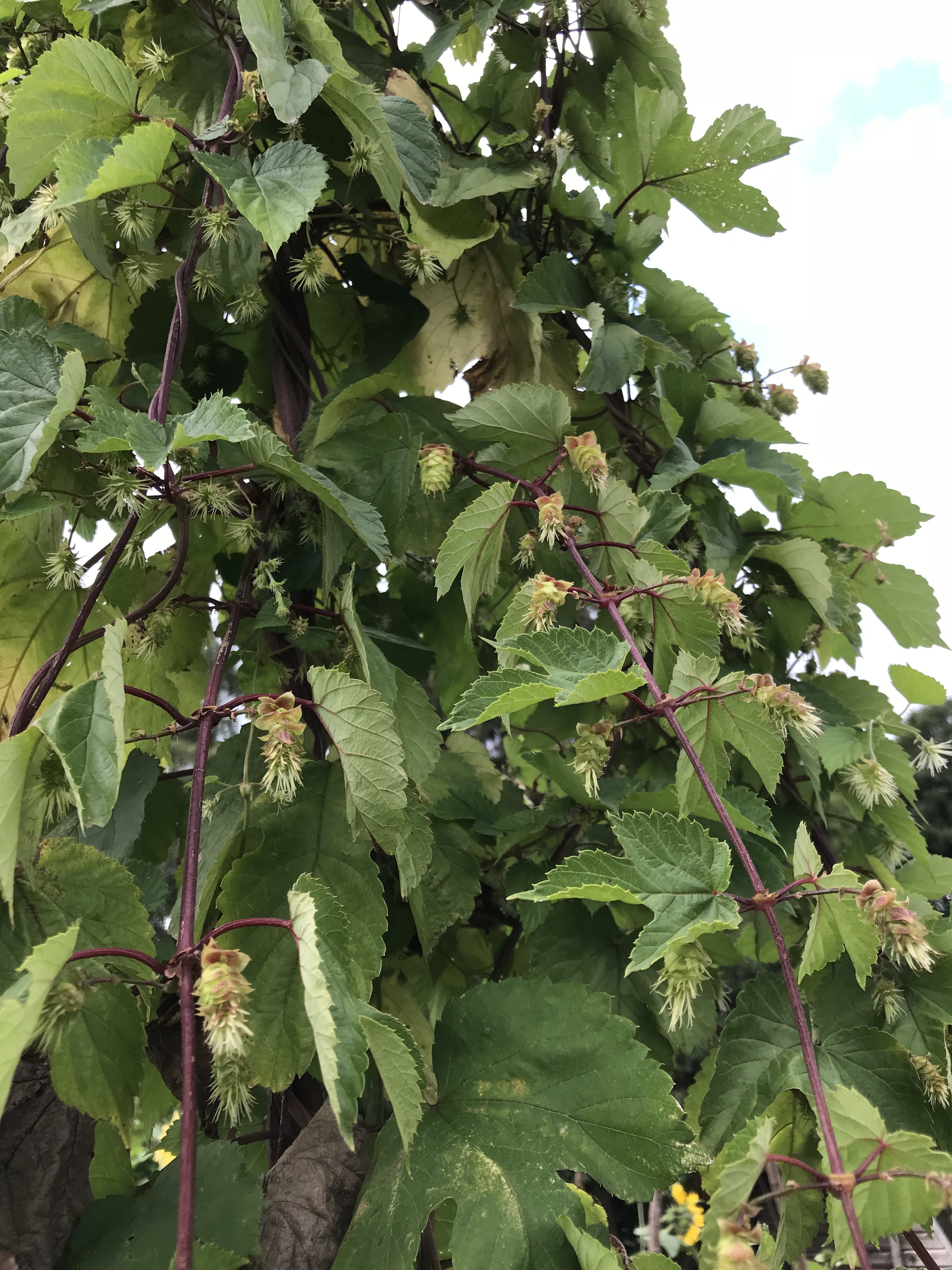
Meanwhile the drop in temperature and damp weather has brought on the hops, which are now covered in these prickly little flowers. I’m on the allotment three times a week to pick the raspberries and gather the sunflowers, dodging showers (not always successfully) and noticing all the jobs that need doing that I don’t have capacity for.

The hops are beginning to flower

Harry and I got caught in a downpour so had to hang out in the ramshackle greenhouse for half an hour

Dad’s monster aubergine demanded some proper attention. These days I prefer recipes that take ten minutes here and there, leaving me free to run the business / remove Harry from the fireplace (his latest favourite place) / organise the wedding etc etc. Moussaka fits the bill perfectly.

Dad with his aubergine

Lots of recipes demand that aubergines are fried first but I dislike this approach for two reasons: 1, you use a shed load of oil, which is both too fatty and too expensive, and 2, it takes forever and is very dull. The best thing to do is thickly slice the aubergines, add a wee bit of oil, then roast in the oven until soft. I’ve added some summer squash to the mix because GLUT.

Roast the sliced aubergines and courgettes

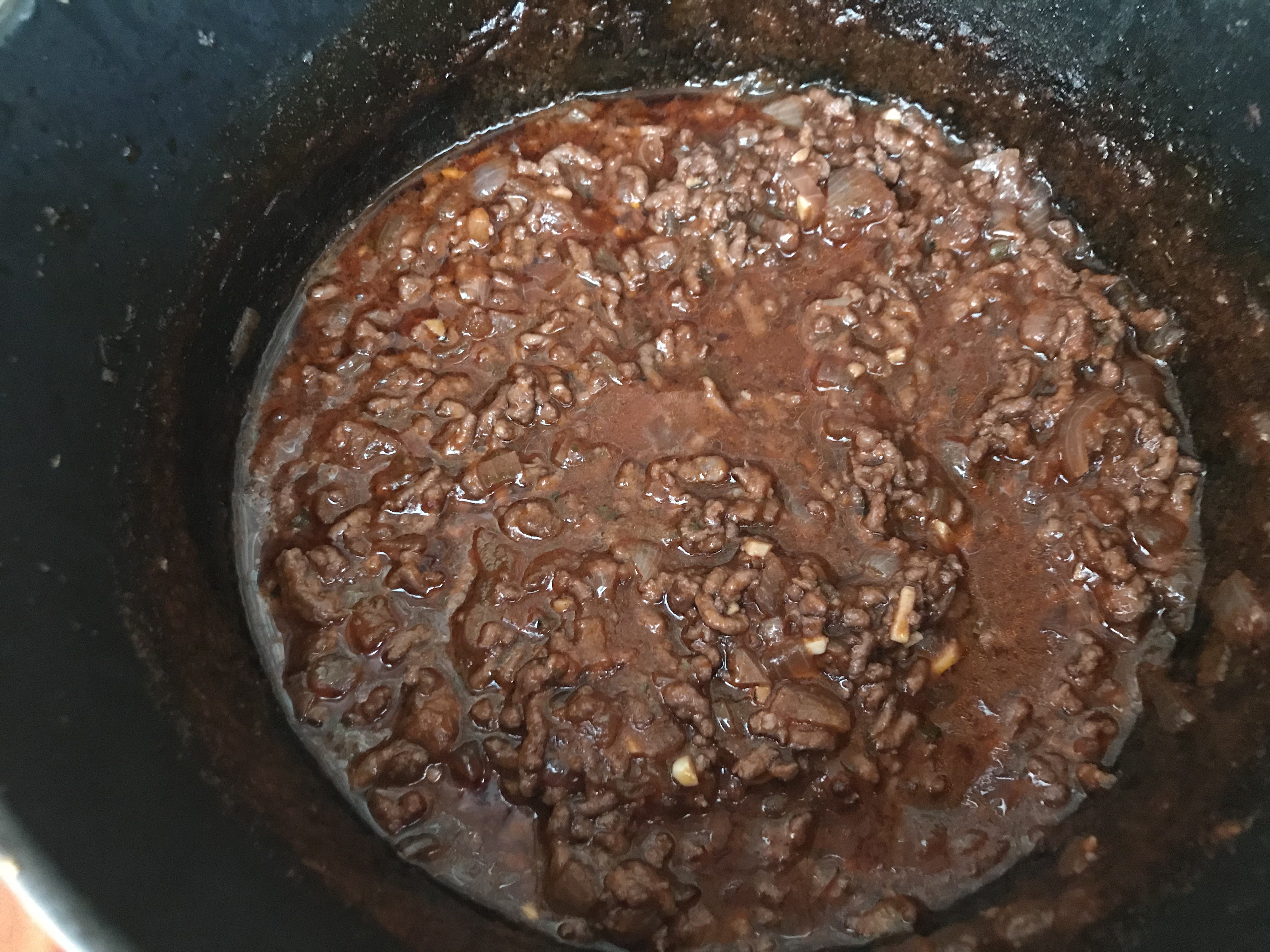
Whilst the veg is roasting away, make a braised lamb sauce. You could use leftover roast lamb here – I think this would probably be better actually – but I only had lamb mince to hand. Simply cook together with onions, tomato puree, cinnamon and red wine until reduced and unctuous. The cinnamon is important, giving background warmth and the whisper of distant sunkissed shores. After an hour of gentle puttering it should be thick and delicious, at which point you can use it straight away or leave for a few hours until you’re ready to finish the moussaka.

The braised lamb sauce

Finally, make a simple béchamel sauce, generously flavoured with nutmeg. Once it’s done leave it to cool for a while, then stir in two eggs for that classic custardy finish.

The béchamel is mixed with eggs and nutmeg

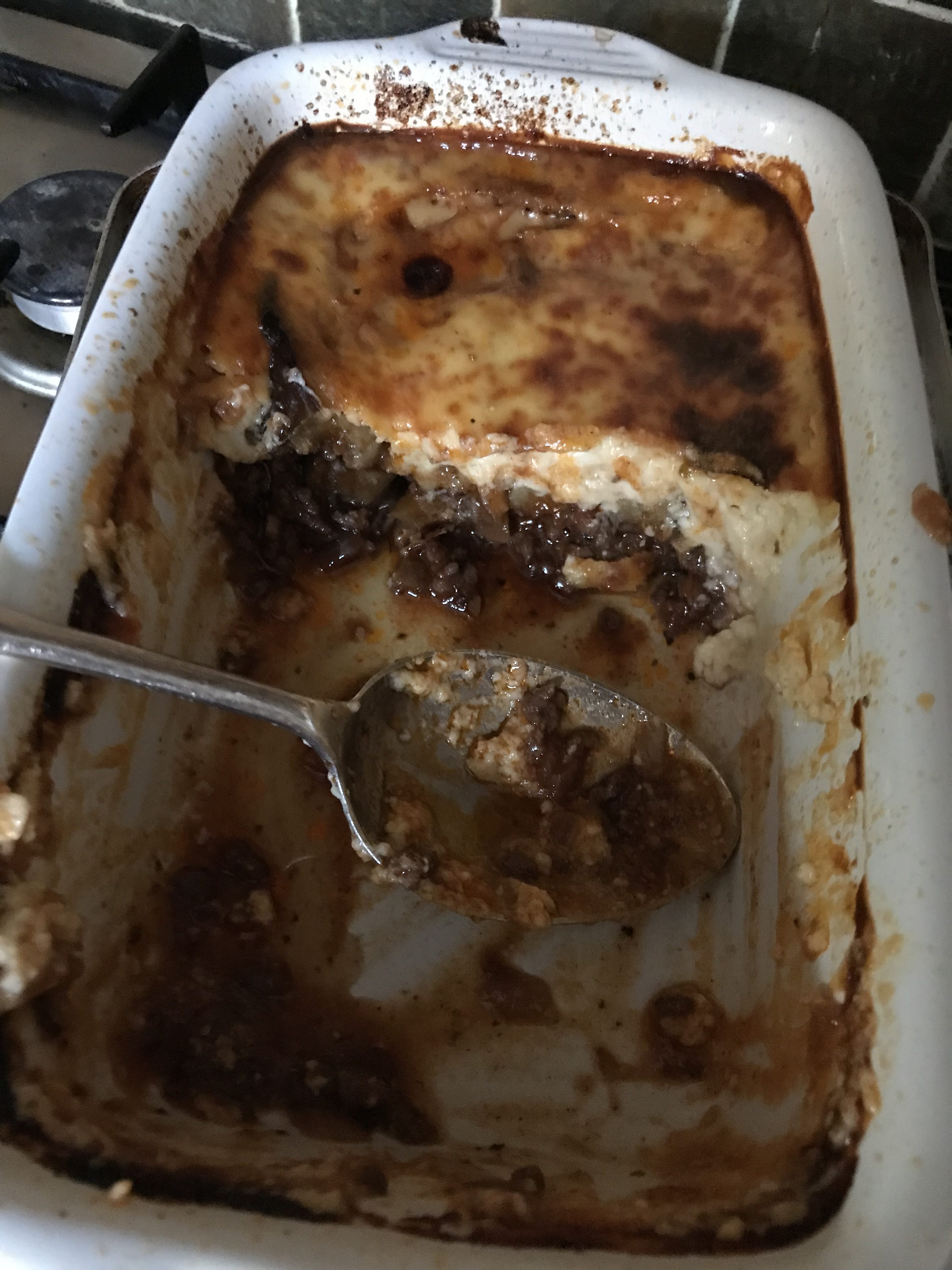
To make the moussaka, layer up your dish in this order: aubergines, meat, aubergines, meat, béchamel. Bake at 180c for about 45 minutes, until the top is blistered and golden. Now – this is VERY important – leave it untouched for at least thirty minutes to calm down and firm up. Hot moussaka is a sloppy horrible mess, but warm moussaka holds its shape and the flavours shine through. Serve with a simple side salad.

Let the moussaka stand for half an hour after baking to allow it to firm up

Moussaka
Inspired by Felicity Cloake’s Guardian recipe. Serves 6 (I made two dishes and froze one)

Olive oil
1 monster aubergine and 1 summer squash / courgette, or 2 large aubergines
1 large onion, finely chopped
4 cloves of garlic, finely chopped
1.5 tsp cinnamon
1 tsp dried oregano
500g minced lamb or leftover roast lamb. Use good quality if you can.
2 tbsp tomato puree
splash of water
150ml red wine
Parsley, chopped

For the béchamel: 
500ml milk
60g butter
60g plain flour
50g parmesan, grated (you could use pecorino or kefalotryi if you have it)
2 eggs
Nutmeg, to grate

Preheat the oven to 180c. Cut the aubergines and squash into thick slices, and place on a roasting tray. Drizzle with oil and season. Bake until soft and golden, about 20 minutes.

Now the lamb. Warm a lidded frying pan or casserole dish on a gentle heat. Cook the onion in a shake of olive oil and a pinch of salt until soft. Stir in the garlic, cinnamon and oregano, then add the lamb. Cook over a high-ish heat until the lamb is well browned and the mixture is quite dry – about 10 minutes. Stir in the tomato puree and cook for another few minutes to get rid of the raw taste, then add in the wine and a splash of water to cover the meat. Turn the heat right down and braise for about 45 minutes until the liquid has evaporated. Stir in the parsley and season to taste. Leave to cool and spoon off any excess oil.

Make the béchamel. Melt the butter in a saucepan, stir in the flour and cook for a minute or two, then gradually add the milk. (Recipes always tell you to use hot milk but who actually does this? I use it cold and stir like mad between each addition to remove the lumps.) Cook until you have a thick sauce and then simmer gently for five minutes to cook through. Stir in the cheese. Remove from the heat and cool slightly, then add the nutmeg and eggs.

Finish the moussaka. In a suitably size dish (or two dishes) layer up aubergine, meat, aubergine, meat and finish with the sauce. Bake for about 40 minutes until well browned. Leave to cool for 30 minutes before serving.

Also this week:

Cooking: Roast leg of lamb with garlic, rosemary and anchovy; roasted vegetable pasta (allotment veg); caramel almond sponge; runner beans braised with tomatoes.

Eating: Pizza at Baked in Brick, Cronut from Medicine bar, Chandigarh veggie samosa and curries

Harvesting: Sunflowers, cleome, dahlia, sweetpeas, cosmos, rudbeckia, last runner beans, loads and loads of raspberries, last blueberries, courgette, squash, cavolo nero, chard, spinach beet. The tomatoes that we’re getting are great and gnarly and red and delicious.

Also: Trying to balance work projects (festival organising, website writing) with baby care with organising a wedding with general life stuff. Re-reading The Summer Book by Tove Jansson and disturbingly obsessed with Say yes to the dress on Quest Red.

Blackberry (baby) muffins

Plague has visited the household. Harry brought home – simultaneously – a vomiting bug, a chest infection and a general got-no-energy malaise. The vomit, dear God, the vomit! He’s now fine of course, but I am in day 10 of being decidedly below par. It’s also the time of year when the biting insects reach peak-feasting mode and I succumb to wearing jungle formula to bed. I know we should appreciate the warm but frankly, I am now ready for drizzle, anoraks and things-wrapped-in-pastry.

Meanwhile the harvest continues. Beans…so many beans, and courgettes, so many courgettes. And great-looking chard, cavolo nero, perpetual spinach, raspberries, blueberries, blackberries, and rather less-great-looking knobbly tomatoes. Plus, whilst not armfuls of flowers, enough for a few pretty vases a week. I also am gratefully receiving the fruit of other people’s labour: just look at this whopper of an aubergine!

My Dad has grown a massive aubergine

Getting two or three baskets like this a week

The sweetpeas, sunflowers, cleome, rudbeckia and cosmos are providing several vases a week

What to do with all these beans!

There’s been a good deal of batch cooking this week. Given that I’m still working and am losing about an hour a day to massive coughing fits, I’m not entirely sure how that’s happened, but there it is. Cooking on auto-pilot. I like to keep a good amount of baby food in the freezer, ready to go, to prevent meltdowns at teatime. Fruity muffins are useful and I’ve been using this River Cottage recipe from their Baby and Toddler cookbook which, in truth, taste way too much like health food to me, but Harry likes them. The purple juice stains, so you must either strip your child before they dig in, or else surrender your power to the washing machine. I choose the latter.

Substitute the blackberries with raspberries, redcurrants, blueberries or apples as the mood takes you. Cooked muffins can be frozen. Defrost at room temperature and maybe given them 20 seconds in the microwave before eating to refresh. Grown-ups may prefer these higher-sugar tayberry muffins instead.

Blackberry muffins
From the River Cottage Baby and Toddler Cookbook

125g wholemeal flour
125 plain flour
3 level tsp baking powder
75g caster sugar
1 tsp ground cinnamon
75g unsalted butter
1 egg
125g plain full-fat yoghurt
125ml whole milk
100-200g blackberries

Preheat the oven to 180c. Sift together the dry ingredients into a mixing bowl. In a pyrex jug, melt the butter in the microwave until just melted. Using a fork, whisk the egg, milk and yoghurt into the butter. Add the milky mixture to the dry ingredients and stir to combine (I use a wooden spoon for this). Stir in the blackberries. Dollop the mixture into muffin cases and bake for about 20mins or until golden.

Blackberry baby muffins

Also this week:

Harvesting: last French beans, runner beans, chard, perpetual spinach, cavolo nero, courgette, tomatoes, raspberries, blackberries, blueberries, cleome, sunflowers, cosmos, rudbeckia, dahlia, sweetpeas. Gratefully receiving beetroots, tomatoes, peppers and aubergine from my folks.

Taking up: bolted lettuce and rocket, lots of annoying thistle weeds

Cooking and eating: Red beans and ham hock, hidden-veg pasta sauce for Harry, Peach cinnamon buns, beetroot salad, mixed veg couscous. A 15% Manzanilla, the first time I’ve enjoyed a sherry since before pregnancy and sign that my liver is improving. Cough mixture.

Reading: The legacy of Elizabeth Pringle by Kirsty Wark, a brilliant portrait of both a Scottish island (drizzle!) and the secret lives of women

Visiting: Tenbury show. Lots of trips to Coventry for work.

Strawberry cheesecake ice cream (no-churn)

We’re approaching glut season. Ten days I go a had a piddling number of quite crappy-looking strawberries, and now I’m picking by the ice-cream-tub full. Same goes for redcurrants and it won’t be long before the blackcurrants, blueberries and raspberries head in the same direction. This is not a complaint of course: loads of strawbs and loads of redcurrants mean a kitchen filled with the sweet fragrant fug of boiling fruit and sugar as I bottle up a year’s worth of jam. Need to wait until the baby’s in bed though; I can not even imagine the horror of attempting jam-making with a 9 month old whizzing around under my feet in his baby walker.

Strawberries, redcurrants, chard, rocket, lavender and sweet william

One thing that can absolutely be made with the kids is this no-churn strawberry cheesecake ice-cream, shamelessly pinched from this month’s Waitrose Kitchen magazine. It uses fresh strawberries (anything to get through the glut), those little caramelly Lotus Biscoff biscuits (I get them from the Pound Shop), and a few other store cupboard items that you’ll have lying around anyway or can pick up cheaply enough. There’s no making of custard or boiling of sugar, and no messing around with ice-cream makers, so it’s simple too AND is surprisingly good.

First, in your food processor or blender, whizz together 235g strawberries with a squeeze of lemon juice and 1 tbsp icing sugar until smooth.

Whizz together strawberries, lemon juice and icing sugar

In a largish bowl, using a handheld whisk, beat a 200g pack cream cheese until soft and creamy, then add 1 tsp vanilla extract, a small pinch of fine salt, and a 397g can of condensed milk. Keep whisking until smooth, then add 425ml whipping cream and whisk until thick with soft peaks.

Whisk together cream cheese, condensed milk, vanilla extract, salt and whipping cream

Finally, in a another bowl, crumble up 60g Lotus Biscoff biscuits. I think it’s important to use these as their intense flavour comes through even when frozen, but you could try a different type of hard, caramel biscuit if you can’t find the Lotus Biscoff ones.

Bash up some Lotus Biscoff biscuits

Then get a tupperware box and fill to halfway with a layer of cream, then fruit and then biscuits. Swirl with a knife to make a ripple effect, then add a final layer of cream, fruit and biscuits. Give it one last swirl with a knife and then put in the freezer until firm, about 5 hours.

Layer the fruit, cream and biscuits into a plastic tub and freeze until firm

Once you’re ready to serve it’s best to leave this at room temperature for ten minutes or so to soften. Word up: this is RICH and a little goes a very long way. But it tastes great. It would also work blackcurrant, raspberry or blueberry…always thinking about the next glut, me. Serve with some more fresh fruit on the side to cut through the richness.

No-churn strawberry cheesecake ice cream

Also this week:

Harvesting: Lettuce, rocket, chard, broad beans, strawberries, redcurrants, lavender, sweet william

Also in the garden: Foxgloves are going over but the delphinium and roses are coming into their own. Sunflowers are stunted by the dry weather but beans are romping away. From my desk I’ve been watching newly-fledged magpies testing out their flight muscles whilst still being fed by their parents.

Cooking & eating: Tarragon roast chicken with broad beans, pecan brownies

Days out: Three Counties Show for Matt’s first Father’s Day and to introduce Harry to his cultural heritage of sheep, cows and men-being-daft-about-old-tractors. David Austen Roses for a cream tea on my birthday. 38 and not out!

SaveSave

SaveSave

Chocolate sorbet

I start with a warning: when grinding steel to make a new top for the hopolisk, remember to wear goggles. Matt failed to do so, got a fleck of steel in his eyeball, and had to go to the hospital for a jab from a doctor with a sharp implement.

When grinding steel always wear a mask, else you may end up with a trip to the eye hospital

With both eyes now intact, we disappeared for a long weekend in the Peak District, which was happily imbued with Royal Wedding spirit, warm sun and abundant blossom. I had forgotten what it is to wake up to the sound of birds and sheep rather than buses – what a life affirming joy it is to be close to the land. Especially the land in May, the kindest of all months.

Abundance of apple blossom at Hardwick Hall, Derbyshire

Cow parsley is at its best right now

A hangover from Christmas on a dry stone wall

Royal Wedding day, and Her Maj and Prince Philip hang out on the roses

Harry loved being away. In the last two months he’s become incredibly skilled on his walker – it’s his passport to freedom. Turn your back for a second and whoooooooosh! He’s off!

Harry tried to escape but gravel stopped play

At the end of 2012 my Dad and I went to Australia to visit my brother, who is based in Adelaide. We had a few days in Sydney, staying in an apartment-hotel directly above Bill Granger’s restaurant in the Surry Hills. I booked the hotel purely on the basis of the Bill Granger connection but ended up not eating there – the prices were so offensively expensive, no sane person can spend THAT much on scrambled egg with avocado. However by happy accident we discovered that the street was full of interesting independent restaurants and food shops including the most brilliant gelataria, Messina. There were queues trailing down the street for this little ice cream shop and when I finally got to the front of the queue I panicked at the masses of choice and asked for a cup of chocolate sorbet whilst thinking “chocolate sorbet? are you mad?”

It turned out to be glorious of course. I went back the next night for another go. I have never forgotten that chocolate sorbet and everytime anyone goes to Sydney I tell them: find Messina! It’s AMAZING! I’ve tried to recreate that chocolate sorbet a few times but never had any joy until I found this recipe, by Angel Adoree in the Vintage Tea Party Cookbook. Her trick is to use proper dark chocolate rather than cocoa, which makes for a smooth texture. I would add that it’s important to ensure that the syrup isn’t so hot as to make the chocolate seize when you mix them together. Use 70% chocolate and you’re all set.

Dark chocolate sorbet
From The Vintage Tea Party Cookbook

Ensure that your ice cream maker is properly frozen before you begin. In a saucepan, melt 200g caster sugar into 500ml water until completely dissolved. Turn the heat off and leave to cool for 5-10 minutes.

Make a syrup with 500ml water and 200g sugar

Meanwhile chop 200g dark chocolate into shards. I used 70% cocoa solids chocolate but it’s nothing posh, just Aldi own brand.

Chop 200g dark chocolate – I used Aldi’s own brand with 70% cocoa solids

Put the chocolate into a heat-proof jug, pour the syrup on top, then stir until the chocolate has melted. Don’t pour boiling syrup onto your chocolate else the chocolate will seize. Put the jug into the fridge and chill thoroughly (about 2 hours).

Pour the warm syrup onto the chocolate, then stir to dissolve and chill thoroughly

When the syrup is properly cold, churn to a slushy sorbet in the ice cream maker, then freeze until firm.

Churn to a sloppy sorbet, then transfer to the freezer to harden up

When you want to serve, take the sorbet out of the freezer for at least 10 minutes to soften slightly. This is really really intensely chocolatey but it doesn’t have the lingering cloyingness of chocolate ice cream. I like it with sliced strawberries and a suggestion of cream.

Chocolate sorbet – lovely with strawberries and cream

Also this week:

Allotment: Planted out sweet peas, courgette, squash, zinnia, rudbeckia, borage, chrysanthemums. Tomatoes went into the greenhouse (hard work – it was 40c heat in there). Finally dug over the sunflower patch. Went on a trip to Worcester to buy new hazel poles for the sunflowers from Worcester Coppice Crafts. With the warm weather, long days, a happy baby and the last few weeks of maternity leave, I’m finding I can get loads done….it’s like a shot of energy and enthusiasm.

Eating & Cooking: Cream tea at Chatsworth Farm Shop, chips at one of the numerous chippies at Matlock Bath. Make a lovely lentil salad rich with mustard and garlic, tossed with sausages and rocket from the garden.

Reading: Travel books written in the 1950s from the wonderfully OTT Lawrence Durrell

SaveSave

SaveSave

SaveSave

Clementine Cake

I’ve been reading up on baby weaning lately and in so-doing, was prompted to revisit Nigella Lawson’s How to Eat. There’s a chapter buried in the back devoted to the feeding of babies….ten days later I’ve yet to get to said chapter for it turns out that this is the most distracting of books, a calming balm for the sleep-deprived cook.

A 1990s classic: How to Eat

Putting to one side the fact that Nigella drops into her introduction that she wrote How to Eat whilst pregnant / nursing (note, this is a whopper of a book with 500+ pages of dense prose. Already I feel inadequate, as I consider it a success if I manage to check my email in the course of a day, never mind write a classic. I suppose being monied helps), I am struck by how ahead of its time How to Eat was. The pages are full of foods that, as a student in 1998, I had heard of but would never dream to encounter: pomegranate molasses, marsala, quince. There is talk of Lebanese supermarkets and popping out for brioche and challah. Meat comes not with a dollop of mash, but with chick pea’d couscous and polenta.

At the time I felt myself to be terribly unsophisticated for not cooking like this on a daily basis (I was, but then so was 99.99% of the population). This was the food of the London sophisticate, recorded unapologetically, in a fashion that is now unpopular in the age of austerity and clean eating. I think I can thank Nigella for widening my culinary horizons… Twenty years on I can remember making some of her dishes – including walking three miles to the Co-op to try to find an aubergine (they didn’t have any) – and was beside myself the first time that I went to an actual real life Lebanese supermarket (it was in north London in about 2006 and the celery was amazing, in full leaf like the most over-the-top floral display).

In homage to Nigella, here’s her clementine cake, which I first made for a New Year’s Eve gathering in the early 2000s. It manages to be sweet but with an element of bitter, which comes from the inclusion of the whole fruit in the batter. I wasn’t so keen on it then, but I now prefer bakes that aren’t too sweet and I think it’s marvellous. Incidentally Sarah Raven has a similar cake in her Garden Cookbook, which I also turn to from time to time.

Clementine Cake
From Nigella Lawson’s How to Eat

First, put 5 clementines in a saucepan and simmer for about two hours, until completely soft. Leave to go cold, then remove any bits of stalk and pips, and whizz to a pulp in the food processor.

Simmer five clementines until totally soft then whizz to a pulp

Next, oil and line a 21cm springform tin and preheat the oven to 180c. Beat 6 eggs until just combined, then add 225g caster sugar, 250g almonds and 1 teaspoon baking powder. (If you’re short on almonds, you can use 150g almonds and 100g plain flour or, even better, a mixture of almonds and breadcrumbs. The cake will be lighter in texture but still good.) Stir in the orange pulp.

As well as your clementine pulp, have ready eggs, almonds and caster sugar (& baking powder, not shown)

Whisk eggs with the sugar and almonds

Add the clementines

Pour the lot into the tin and bake for about an hour. The cake will likely need to be covered with foil after about 40 minutes to stop it browning too much. Cool in the tin and then turn out, to be served naked or with cream and a dollop of fruit (rhubarb compote would be excellent).

Once baked – a not-too-sweet cake for tea or pudding

SaveSave

SaveSave

SaveSave

SaveSave

SaveSave