5 hour Easter lamb

Easter is my favourite of all the bank holidays. There’s none of the excesses of Christmas, the food is great, it’s often a time for a genuine holiday (rather than running around stressed from one family engagement to another) and there’s a sense of optimism in the spring air. What a humdinger of an Easter we’ve just had, with shorts and ice creams being the order of the day.

This year’s geometric Easter cake

I spent a happy half hour on Easter Sunday drawing up this year’s allotment plan. The idea is to separate the two main beds into vegetables and cut flowers, and then attempt to block plant in each, partly for ease of harvest but mostly because I think it will look great. In reality I may have to shift this plan around – there may be just too many plants for either side to contain.

The low-fi allotment plan for 2019. Separate plots for vegetables and cut flowers, with plenty of blocks.

Yesterday was a full day of allotmenting, the first for months and months. And actually, the first with Matt for probably around a year. He got to work raising the hopolisk whilst I removed the black plastic that has been covering our two main beds and tackled the tufts of couch grass that are at constant threat of taking over entirely. Perhaps optimistically, I also sowed a line of parsnip and carrot, knowing that direct sowing rarely works well on our plot…but this year I have a feeling that they’ll come good.

Sowing parsnips next to the sweet rocket and broad beans

Matt has laid plastic near the brook in an attempt to curtail the spread of wilderness as it reaches peak summer growth

The hopolisk is risen, as are the bean sticks.

Removing grass is hard, hard work. Since having Harry I’ve noticed that my general fitness has grown poorer and on the allotment I realised why: full days like these, lugging around trugs of turf and crouching in currant bushes, are the best way to stay strong and flexible and yet I rarely get the chance these days.

But back to Easter food. If it’s Easter then lamb is probably on the menu (as well as chocolate cake adorned with mini eggs, obviously), but – to be controversial – I think that the traditional English roast doesn’t quite hit the spot. What I want is lamb that’s been cooked for so long that it is shreddably tender, full of flavour, and with some chewy gnarly caramelised ends. In the summer I might cook a boned leg of lamb in the kettle barbecue for an hour or two, but this Easter I went for a Middle Eastern-inspired half shoulder, rubbed with spices and then baked – fully encased in foil – for 5 hours. It was sensational. No photos I’m afraid, but here’s the recipe:

5 hour Easter lamb

The day before you wish to eat, take a half shoulder (or a full shoulder if feeding a crowd) of lamb and trim any excess fat. Leave the bone in for good flavour. Place in a bowl with three or four big bashed cloves of garlic, a good pinch of cumin seeds and dried chilli flakes, about a tablespoon of sweet smoked paprika and the same of ras al hanout (I used the blend brought back from Morocco a few weeks back by Claire Fudge). Salt and pepper generously, add a splash of oil and really massage the flavourings into the meat. Cover, and leave to marinate in the fridge overnight.

The following day, preheat the oven to 140c. Place a large sheet of foil in a roasting pan, put your lamb and the marinade on top and squeeze over the juice of one orange. Cover with more foil and bring the edges together to make a tight seal. Place in the oven and leave to putter away for 4 to 5 hours, checking every hour that it’s not drying out – if it is, and this is a vital step, add a splash of water from the kettle to your foil parcel, then re-seal. (The foil is important unless you want to spend hours with a scouring pad.)

As it cooks, the lamb will become more and more tender, and the edges and juices will become more and more caramelised. When the lamb is meltingly tender, remove from the oven and increase the heat to 200c. Remove the top layer of foil and siphon off any juices – if they’ve overly caramelised then you can start again by moving the lamb to a fresh foil base. Blast the meat for another 20 minutes until the top is caramelised and crisp.

To serve, shred the meat into large chunks. We enjoyed ours with tahdig from Claudia Roden’s Book of Middle Eastern Food, a glorious way of cooking rice that makes it as buttery as popcorn, plus a mezze of broad beans, garlic, mint, dill and yoghurt; another of cucumber, onion and yoghurt; chopped tomatoes and masses of new season asparagus.

For leftovers, Matt made Persian burritos. Take a tortilla, then stuff with leftover tahdig rice, refried crispy lamb, yoghurty cucumber and a spot of cheese. Serve with sweet potato chip and salad. Glorious.

Also this week:

Allotment and garden: Sowed leeks and carrots. Removed black plastic from the main beds and placed some over the back wilderness. Heavy weeding of the edges of the main beds and around the currants. Raising of the hopolisk. Building of bean sticks. Matt has started to dig a hole for the foundations of a new shed and is muttering about re-building the greenhouse.

Cooking and eating: 5 hour lamb, tahdig, broad bean and yoghurt mezze, Persian burritos, thousands of chocolate crispy cakes, never-ending Easter chocolate cake, Mum’s salmon with tarragon sauce and asparagus, Mum’s cheesecake, baked chicken with lemon and honey at the farm with the university gang, salad of avocado, edamame and tender stem broccoli at Arco Lounge that was surprisingly good. Harry had his first Calippo (except he didn’t as it was a fake Aldi version) and enjoyed it immensely.

Reading: Fasting and Feasting: The Life of Visionary Food Writer Patience Gray by Adam Federman.
The full sowing list

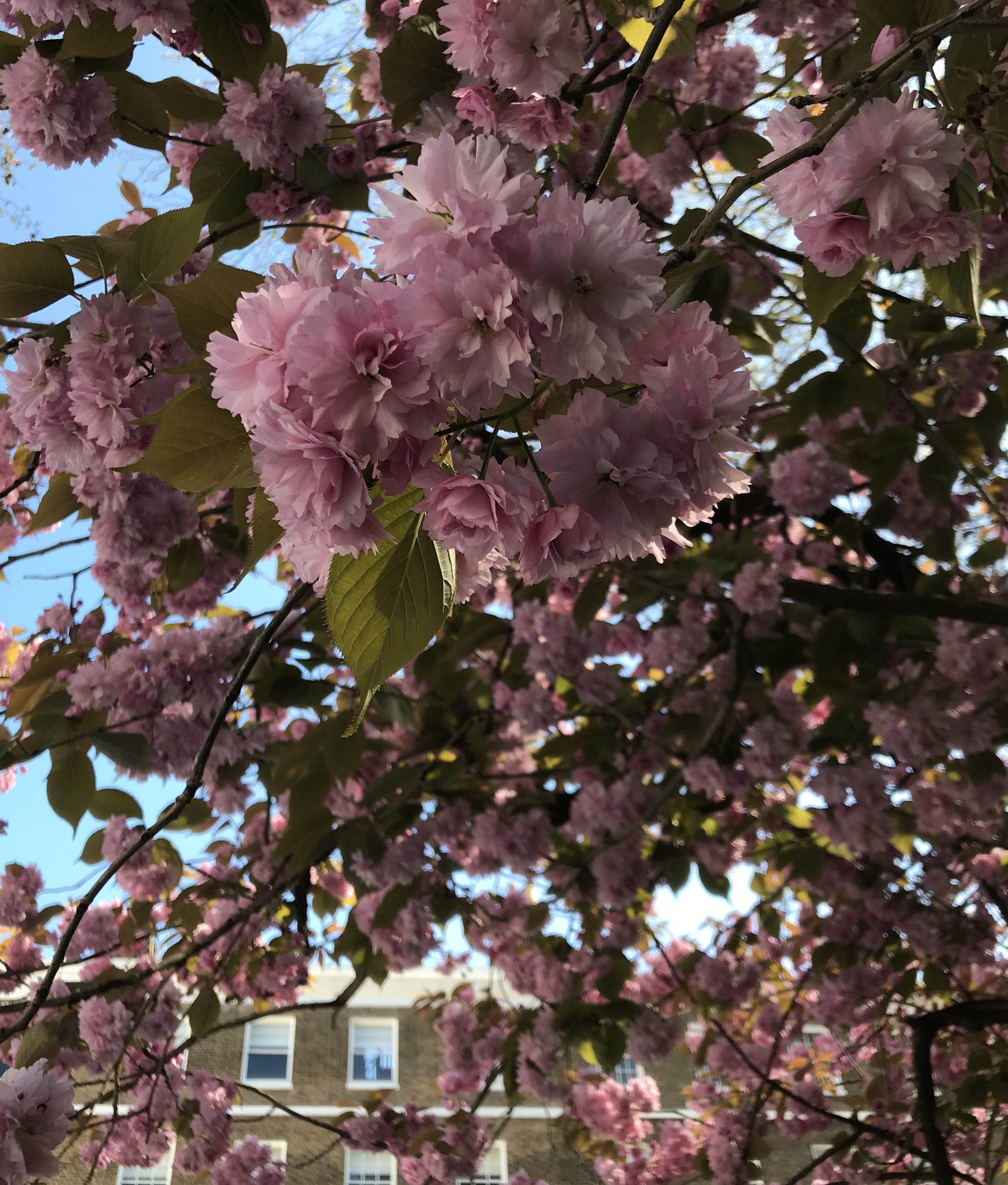
There’s still chill in the air but the natural world is marching on. Trees are in bud break, the back garden is rich with verdant greens and yellows, and cherry trees are full of ethereal pink blooms. Weather like this sends my asparagus radar twitching so I headed to Hillers on Saturday to track some some of the first English stems of year – this, along with the first (glasshouse grown) tomatoes and strawberries that are always around at the same time, is one of my favourite food shops of the year.

Cherry blossom outside the Wallace Collection, Marylebone

First asparagus is hitting the shops

Compared to previous years, I have so little time for anything these days. So it’s pleasing to see that both allotment and garden are getting on quite nicely with very little intervention from me: snowdrops, primroses, daffodils, alliums, aquilegia, foxgloves…all are blooming or fattening quite happily of their own accord. It’s the gardening equivalent of making bread: a few small interventions now and then, but generally you must leave nature to do its own thing, rise when it’s ready.

Big fat allium heads are swelling

Having said that, I’ve been finding the odd half hour here and there to carry on with seed sowing. The list of plants that I’m growing from seed is impressive but the reality is (despite the lack of space) it’s all pretty easy. A bit of thinning, a bit of turning and watering, a spot of potting on, and in a few weeks we’ll have a productive allotment without spending a fortune.

Sowing runner, climbing, French and borlotti beans

The Sun Room is full to the brim with pots and trays

This is the full list of seeds that I’m trying this year; I’ve now started off all of these with the exception of parsnip and fennel (waiting for the weather/soil to get a little warmer).

Flowers

Sunflower Valentine
Sunflower Ornamental Multicolour mix
Sunflower Magic Roundabout F1
Sunflower Red Sun
Sunflower Giant
Nigella Persian Jewels
Nigella Double White
Achillea Millefolium Cerise Queen
Cosmos Pied Piper Blush White
Cosmos Double Click Cranberries
Cosmos Velouette
Ammi Majus Graceland
Salvia Farinacea Blue Bladder
Delphium Exquisite series, White King
Delphium Exquisite series, Blue Spire
Cornflower Snow Man
Cornflower Double Blue
Limonium Suworowii
Calendula Indian Prince
Helichrysum bracteatum monstrosum (Strawflower) Paper Daisy
Cleome Colour Fountain
Baptisia Australis False Indigo
Mexican Hyssop
Brachyscome Multifida (daisies)

Veg

Courgette Soleil
Courgette Bianca di Trieste
Courgette Costata Romanesco
Summer Squash Custard White
Pumpkin Cinderella
Broad Bean Aquadulce Claudia
Broad Bean Crimson Flowered
Leek Musselburgh
Climbing Bean Cobra
Climbing Bean Cosse Violette
Borlotti Bean Lingua di Fuoco
Dwarf French Bean Tendercrop
Runner Bean Scarlet Empire
Parsnip Gladiator F1
Carrot Nantes 5
Fennel Montebianco
Tomato Costoluto Fiorentino
Tomato Gardener’s Delight

Greens
Chard Bright Lights
Kale Pentland Brig
Kale Russian Red
Kale Cavolo Nero
Spinach Perpetual
Beetroot Leaf Blood Red (also pleasingly known as Bull’s Blood)

Salads & Herbs
Lettuce Catalogna (a type of oak leaf)
Salad rocket
Tuscany salad mix
Viola Heartsease (a flower but I put it in salads)
Basil Thai
Basil Sweet green
Dill
Green Fennel

Finding the space to plant out all these DOES worry me, but I’ll cross that bridge when I come to it.

Also this week:
Cooking and eating: The start of Easter treats, crispy cakes, mini eggs and hot cross buns. Fairy cakes studded with raisins; Meatballs baked with aubergine, tomato, orzo and mozzarella; Baked cod with fennel, capers and blood orange; First asparagus of the year; Beef shin braised with pasatta, rosemary and rose wine; apple crumble.

Rocket and hazelnut pesto

We’ve had a week of outdoorsing it. I took Harry up to Malvern to collect spring water and see how the wild garlic is looking – pleased to report that it’s at its peak right now. We scooped up a few fistfuls (not so much as to cause any damage to the plants, which are innumerable in my secret foraging spot) which Matt then used as the basis for a chimmichurri sauce for steak. Whilst home, we headed to Clive’s to check out the chickens.

Wild garlic is in peak form right now

Toddler living his best life

Then this weekend we headed out to border country, Hay on Wye. I used to spend a lot of time in this part of the world and sometimes have deep, physical yearnings to be amongst the cool, damp air, mountains and green. The green of Herefordshire is something else. On Hay Bluff, sheep grazed amidst the aftermath of a recent snow storm, and as we wound our way down the mountainside to Llanthony Priory, streams broke their banks onto the road.

A view from Llanthony Priory

Which all sounds very romantic until you remember that Harry sees 11th century ruins as a potential playground, and regards country roads as BORING.

The reality of taking a small child to a heritage venue

Back to more practical matters. The allotment rules dictate that bonfires are allowed only in the months of November and March, a fact I had forgotten until a few days before the end of the month. Matt went down there in a brief gap between family commitments (Mother’s day lunches and Grampy’s 99th birthday party) armed with a blow torch (yes really) to destroy some of last year’s detritus.

Managed to sneak in a bonfire before the end of March

Meanwhile I used the brief hour of calm after Harry’s bedtime / before Matt gets home to whip up a vat of leek and potato soup for when I hosted a working lunch the following day. Soup is fine as far as it goes – easy, cheap, nutritious – but it can be dull. A spoonful of this rocket and hazelnut pesto, stirred in on serving, gives the poke that it needs. I turned to rocket as I had some in the fridge – ditto with the hazelnuts, I just happened to have some on hand – and was delighted at the results. I can’t help but think that some of the wild garlic from the previous weekend would have also been a welcome addition.

No quantities with this, you just have to use your eye and trust your tastebuds. In a food processor, blitz together a few handfuls of rocket, a handful of basil or Greek basil, a small clove of garlic, a chunk of parmesan, handful of hazelnuts, small pinch of salt, small squeeze of lemon with a trickle of the best olive oil. Keep blitzing until smooth, taste, then adjust your seasoning as you fancy. Keeps in the fridge for several days.

Rocket and hazelnut pesto

Also this week:

Growing: Started off rocket, dill and violas. The dahlias that I potted up a few weeks back are starting to sprout.

Eating & Cooking: Leek & potato soup with extra chard for vitamins, wild garlic chimmichurri, beautiful canale bought from the market at Hay on Wye

The allotment season begins

For the past few weeks, there’s been a table of green seedlings in the sun room. Then the table of green was joined by several trays of dahlias, then a few more trays of rocket, cosmos and sunflower, and now there’s barely room to breathe.

Taking full advantage of our south-facing sun room

Particularly pleasingly, the false indigo that I started back in February have germinated. This was the tricky one that demanded scouring with sand-paper, piercing with a needle, soaking and heating – obviously I did none of these things, taking the view that if a plant has to be molly-coddled that much, then it’s not going to survive on our plot.

False indigo has germinated

Remembering my notes from last summer, I’ve been fastidious about thinning my seedlings this year. Thus far they’re all looking pretty healthy – but when I visit the allotment (for the first time in weeks) I’m confounded by all the new green life erupting, wild plants crammed in together, battered by floods and winds and all the stronger for it. I have yet to attempt making a stinging nettle risotto from allotment weeds but this spring may be the time to try it.

Speaking of winds, March’s gusts have left the greenhouse in an even sorrier state of affair. Two more panes of glass have slid out, leaving dangerous shards in the wilderness area. I’m pleased that I’m growing only the hardiest of tomatoes this year as what is left of our greenhouse will offer the slightest of protection against the elements; it will be a miracle if the structure lasts another growing season (every time I step in there I wonder if glass is going to rain down on my head).

The wilderness is re-erupting, with tasty-looking stingers.

Another greenhouse pane met a sorry end

The point of today’s visit was to plant out the broad beans, which have grown strong and fat in the cold frame. Two varieties this year – aquadulce claudia, which should flower pretty soon, and the pretty crimson flower. I’m also having a go at direct sowing a few rows, which never seems to go well on our plot but with the soil warming nicely, it’s worth the experiment.

Broad beans planted out

Really healthy plants this year

It’s still sparse out there, of course, but there are a few heartening clumps of green. The sweet rocket is galloping into growth, as is the sorrel, and there’s still pickings to be had from last year’s chard lucullus and beet spinach.

Sweet rocket is galloping into growth

Still pickings of chard and beet spinach to be had

On the To Do list: Start Sowing The Veg.

Also this week:

Sowing: Cosmos, sunflower, cornflower, rocket, brachyscome, achillea millefolium (yarrow)

Cooking and eating: Victoria sandwich with homegrown and homemade jam, rhubarb, apple & amaretti crumble with Jean’s rhubarb, noodles and pork tossed in kecap manis.

Plus: More illness – chest infections, blood tests & x-rays; visited Leicester museum to look at their Arts & Crafts collection.


Chicken jalfrezi

The false spring was there to make fools of us, just as I predicted. Since my last post we’ve had two big windy storms, big enough to take down branches, plus yesterday brought the heaviest hail shower that I’ve experienced for several years. But the lighter evenings do bring a sense of relief and the spring equinox is shortly upon us, time for a resurgence of energy and resolution.

Speaking of energy, Harry and I both succumbed to chest infections, which are now on the way out, but point to the importance of nutrition and rest. Last week I experimented with purple pancakes – these are American-style pancakes with blueberry compote stirred into the batter before cooking – which gave us a good dose of protein, calcium, carbs and (most importantly) fun.

Harry loves purple pancakes. Make a regular pancake batter and swirl into a few tablespoons of blueberry compote, then cook as normal.

There was also a trip to Ludlow, home of the world’s greatest butchers and greengrocer, to restock the freezer with proper sausages, bacon, a bunny or two plus a sensational leg of pork.

March in the Marches – the view across the river to Ludlow castle

An abundance of spring flowers at Ludlow market

Back home, the garden is changing from brown to yellow. The forsythia came into bloom last week, with its optimistic bright yellow flowers hanging from branches like fairy skirts. The primulas that we lifted from Granny’s garden before she passed are thriving – a softer yellow than the forsythia, they provide pleasing pops of colour that can be seen from the sun room.

More yellow, this time from the blooming forsythia in the back garden

Granny’s primroses are thriving

Meanwhile I have a space issue. Our Victorian house contains only 1 windowsill and 1 smallish cold-frame, meaning that spring-time seed sowing is an exercise in logistics. It’s a constant juggle of succession sowing and tray-turning to get things started. This year I have unfathomably got about 40 different varieties of flowers, herbs and veg that need sowing over the next month or two, and only a postage-stamp amount of room to keep them in (Matt promises that he will apply his hive-mind to this issue). Meanwhile I have also (equally unfathomably) amassed a collection of nearly 20 dahlias, all of which I potted up yesterday in the hail, and which are now snuggly resting in big trays in the sun room to begin their ascent to full-flowering August glory. My labelling is dubious at the best of times but I particularly enjoyed unwrapping the bag-for-life full of shrivelled tubers and a single pink Post-it noting “jewel colours for garden or allotment”. I have absolutely zero idea where these came from but I look forward to seeing how they progress.

Somehow I have amassed a collection of dahlias, all of which are dubiously labelled, now potted up after their winter snooze.

Cold frame already full with broad beans and delphinium seedlings

On to today’s recipe. Since the Frugality Challenge I have become very aware of using meat to its best potential, so that it lasts for loads of meals. The other week I bought a large whole chicken, took it down to its essential parts (2 breasts, 2 drumsticks, 2 wings, 2 thighs, carcuss) and froze each piece individually. This is far more economical way of shopping than buying lots of individual packs of thighs or breasts, plus the portions tend to be larger – and thus better value – when taken off a whole bird.

The legs were marinated with yoghurt, garlic and spices brought by my friend Claire from her recent trip to Morocco (thanks Claire), before being baked and served with flatbreads and salads.

The breasts were turned into this wonderful jalfrezi, from Jamie Oliver’s Super Food Family Classics book. I love that it’s very simple, very healthy and genuinely delicious, plus there’s no special ingredients needed, as it’s made with store-cupboard and fridge staples. This does involve whizzing up a curry paste but even that isn’t too much bother, and the chicken can be marinated in advance if that makes life easier. We ate it up with rice, home-made tarka dal, a chopped salad of cucumber, tomato, onion, mint and coriander, plus Matt’s vegetable pakora. Highly recommended.

Chicken Jalfrezi
from Jamie Oliver’s Super Food Family Classics. Serves 3-4 with side dishes.

For the paste: Toast 2 teaspoons of cumin seeds with 1 teaspoon each of coriander seeds, fenugreek seeds and black mustard seeds in a dry frying pan until toasted. Tip into the food processor with 2 cloves of garlic, a big knob of ginger, 1 teaspoon turmeric, a pinch of salt, 2 tablespoons vegetable oil, 2 tablespoons tomato puree, 1 fresh red chili and a handful of fresh coriander. Whizz the lot to a puree, adding a splash of water if needed.

Slice 1 large or 2 small chicken breasts into large chunks, then place in a bowl with 2 tablespoons plain yoghurt, the curry paste and a pinch of salt. Massage the paste into the chicken then set aside to marinate.

Dice one red onion and two peppers (red, yellow, green, or a mixture) into large chunks. In a dry frying pan or casserole, stir-fry the vegetables until they start to char – this gives good flavour to the curry. Tip in the chicken and any excess marinade, then cook for 3-4 minutes until the chicken begins to turn opaque.

Tip half a tin of chopped tomatoes into the pan with a good splash of water, stir to combine, then leave to cook on a low heat for 10 minutes until the chicken is cooked through, the veg is softened and the sauce is thickened to your liking. Check the seasoning – add a squeeze of lemon if you like.

Serve with rice, daal, salad and raita.


Also this week:

Cooking & eating: Ludlow pie and chips; chocolate muffins; blue pancakes; cherry flapjacks; Moroccan-baked chicken; apple & blackberry galette; hot cross buns; roast pork shoulder with crispy crackling; phenomenal amounts of tea.

Outside: The conifers at the end of the garden were removed this morning, opening up massive amounts of light into the wilderness.

Reading: Mildly obsessed with Up: My lifetime’s journey up Everest, Ben Fogle’s account of climbing Mount Everest. Make mental note that life has become dull and so, whilst I have no desire to climb any mountain whatsoever, we should plan some adventures for 2019.

Vietnamese-style dressing

The warm temperatures of the last two weeks have brought the seedlings, bulbs and buds on no end. Let’s not be fooled too much – False Spring is a thing – but there’s definitely a sense of sap rising. We’ve been out for our first ice cream of the year, albeit in thick coats, and the daffodils in the back garden are singing in their bright yellow trumpets.

Never too early in the year for ice cream

Narcissi ‘rip van winkle’

The early seedlings are germinating impressively. This year I am being far more fastidious about thinning, and the tray is being rotated daily to prevent too much legginess. The broad beans that Harry planted back in January took weeks to get going, but once they did then whoooosh, they were off! Now several inches tall, I’ve moved the seedlings to the cold frame to harden off.

Germination going well, rotating the tray daily and using the heat-mat

Harry’s broad beans took AGES to germinate but now are thriving

Matt’s been away all week, therefore living on Pret and McDonalds (not that he’d admit to it), so come Saturday I was determined to get some vitamins into our addled bodies. Vitamins doesn’t need to mean boring though. Alongside stir-fried lemongrass chicken and broccoli I pulled together a crunchy, vibrant, searingly hot Vietnamese salad – it’s the kind of cooking that is so satisfying that you don’t realise that it’s healthy. This would usually have green papaya and Chinese leaf in it but I had neither, so subbed in a firm, not-quite-ripe mango, plus turnip for crunch. Turnip and mango sounds awful, right? Wrong – try it and be surprised. The joy of these salads is that you can use anything crunchy that you have to hand, though I do think that cucumber and shallot are essential.

Vietnamese-style salad

Julienne a bowlful of crunchy vegetables – use what you have to hand, but carrot, shallot, turnip, kohl rabi, Chinese leaf, cucumber, white cabbage, firm mango, yellow pepper and beansprouts all work. Toss in a handful of mint, basil and coriander (again, use what you have to hand) and some chopped, toasted peanuts for crunch, if desired.

The key to this is the dressing. Make it as hot as you dare! Whisk together 1 tbsp fish sauce, a good squeeze of lime, 1/2 tbsp Japanese rice vinegar, 1/2 tbsp caster sugar and very finely minced garlic and red birds eye chili (to taste). Pour onto the vegetables and leave to stand for a few minutes for the flavours to mingle before serving.

Also this week:

Cooking: Cherry brownies, blackcurrant bakewell tart, lemongrass & ginger chicken with broccoli, Welsh cakes, cherry almond loaf cake
Growing: Cleared out the front garden, taking out the fern and an unidentified variegated evergreen (a family joint effort, this).

First seeds of the year

It feels like the year is warming up. Both literally – I was outside in just a thick jumper earlier today – but also in terms of stuff. After the confines of January, so far this month we’ve been to the British Indoor Championship athletics at the NIA, had a lovely day trip to the Cotswolds, been out for a fancy Malvern lunch (with a baby! Imagine!) plus there’s new work projects to occupy the mind and hopefully help the bank balance a little. It’s a relief to feel like we’re living again. Plus of course there’s been baking.

The BEST cinnamon buns

Valentine’s fairy cakes

Encouraged by blue skies, I’ve made the first few exploratory trips to the allotment of 2019. The raspberries require cutting back and the blackcurrants pruning, both jobs that I do not relish but actually, amidst the growing bird song and with a faint whisper of sun on my back, were enjoyable enough.

The first few exploratory visits to the allotment of the year. Daffodils are nearly out.

This year’s seeds were delivered a few weeks ago and have sat waiting on the side for some attention. I want to shake things up a little, so there’s new varieties of cut flower to try, and old-favourite veg to have another go at. With 5 summers on the allotment under my belt I am now more confident with my planting but still willing to make a few mistakes in the name of experimentation. With that in mind I’m trying a new seed company this year – Chiltern – who don’t go in for glossy photography and are therefore cheaper than my usual Sarah Raven.

This year’s seeds are here, with some new varieties to shake things up a bit

Today I finally got around to sowing the early starters. There’s the standard leeks and tomatoes, plus newbies to the allotment party:  agastache mexicana (Mexican hyssop), baptisia australis (fake indigo), delphiniums, crimson-flowered broad beans and – deep breath – helichrysum bracteatum monstrosum, also known as straw flower, which I saw growing at Baddesley Clinton last autumn and thought it was wonderful in its kitsch-ness. I’ve taken scissors to the trusty black seed trays, splitting them into 4 blocks of 10 plugs, to make them more easy to move around: when you’re sowing in confined spaces, you have to make life easier for yourself.

The age-old plastic trays have come out again

Sun-room is starting to fill up

According to the worryingly-bossy seed packet, the baptisia australis require 6 weeks in the fridge and then another few weeks sunbathing at 20c, or some such. The delphiniums are equally as fussy. Really, who can actually provide these conditions? I decide to stop worrying and just give them a go: they’ll either grow or they won’t, and that’s all there is to it.

Delphiniums go into the cold frame

The bulk of the year’s planting won’t begin for another month or so, but it’s pleasing to feel that spring has begun.

Also this week:

Eating and cooking: Steamed syrup sponge, venison in red wine, chicken and chickpeas with tomato, paprika and cinnamon.

On the allotment: Pruned the soft fruit, cut back the raspberries, removed the brassica cage so the birds can have their fill

In the sun room: Started off tomatoes (gardener’s delight and costoluto fiorentino), leek musselburgh, broad bean crimson-flowered, cleome, delphinium (white king and blue spire), false indigo, Mexican hyssop, strawflower, ammi majus.

Reading: Re-visiting How to be a domestic goddess and feeling inspired to make fairy cakes again. Once again I see how Nigella’s early books were ahead of their time in their vision and flavour combinations.

Nordic baked pancakes

Bit nippy isn’t it? In the last fortnight I think I’ve been outside maybe twice. Once to look at snowdrops…

Snowdrops are peeping in the garden. I planted these in the green last spring so hopefully now they’ll start to spread and establish.

…and the other because Matt wanted to watch the Stourbridge Stagger 10k running race.

This picture gives no indication of how painfully cold it was in Stourbridge yesterday.

The rest of the time I’ve been finding indoor pursuits, including finally planting the broad beans that I meant to sow back in November, and lots and lots of cooking.

Harry planted his first seeds last week – broad bean Aquadulce Claudia

There’s been braised ox cheeks with ancho, a massive chocolate meringue cake, spicy lamb kebabs, tzatziki with flat breads and the first – glorious – rhubarb bellini of the year. Actually, the first for three years, as in 2018 the booze made me feel too poorly and in 2017 I was pregnant. I spent a fortune on the precious pink stems and, for once, I don’t regret a penny of it.

Harry is a fan of tzatziki

First rhubarb bellini in three years!

I know there are some who give up booze and carbs and dairy and joy for January, but I think you need to find whatever sustenance you can to get through these icy-cold days. This recipe for Norwegian baked pancakes is just the ticket. This baked pancake has a greater proportion of egg and milk to flour than our normal pancakes and so it cooks into something more like a custard than a pancake.

Norwegian baked pancake

Bakes to a rich dense custardy mass

I found the recipe in the Nordic Baking Book, which is a dense encyclopaedia of all things to do with Scandi baking. The author, Magnus Nilsson, is EXTREMELY particular about the way things are done (and quite rightly too as this is meant to be a documentary book). However at home we can have more leeway. If you prefer a more cakey pancake, just add a few more spoonfuls of flour. The original has no sugar in it – though you could add some if you like – making it an ideal accompaniment to morning bacon or maple syrup and berries. It will happily keep in the fridge for a few days after baking.

Thick Norwegian oven-baked Pancake – Tjockpankaken
From The Nordic Baking Book by Magnus Nilsson

25g unsalted butter
125g plain flour
2 eggs
pinch of salt
500ml milk

Preheat the oven to 220c. Place a baking dish large enough to hold your mixture into the oven to warm – I used a 8inch round pie dish. Add the butter to the dish and return to the oven to melt.

Combine the flour, eggs, salt and half the milk in a bowl and whisk until no lumps remain. Add the rest of the milk. (This bit is just the same as for making Yorkshire Puddings).

Swirl the melted butter around your dish to coat. Add the batter and return to the oven to bake. Cook for 30 minutes until dark golden and completely set. Leave to stand for 5 minutes before serving.


Also this week:

Cooking and eating: Beef cheeks braised with ancho and tomato, golden wholemeal soda bread, golden oat and raisin cookies, rabbit braised with root veg and pearl barley, chocolate dacquoise, chocolate meringue cake, rhubarb bellinis. Harry’s first trip to Original Patty Men.

Reading: Becoming by Michelle Obama – from the library rather than giving Amazon any more ££.

Also: Just trying to keep warm.

Jean’s apple plate pie

Matt comes from a family of home-bakers. I’ve written before about how Granny used to make hundreds and hundreds of mince pies at Christmas, selling them to friends and neighbours. Her skills extended to apple pie too – the apple trees in their garden (presumably planted by Grampy) produced a massive crop and so Granny would turn the windfalls into foil-wrapped bakes that she supplied to her loyal following of customers.

Granny and Grampy’s house – note the apple trees and rows of chrysanthemums at the back

Matt’s family playing next to those amazing apple trees. Granny is wearing the blue cardigan.

Granny passed away in 2017, and her house and the apple trees are now sold, but her apple legacy lives on. Matt’s Mum, Jean, carries on the tradition with her perfect, melt-in-the-mouth apple plate pie. She made one at Christmas which Harry practically inhaled, it was so good, and I couldn’t help but compare this masterclass of good, old-fashioned pastry work with my rather clunky attempts. Plate pies are uncommon now, with restaurants and bakeries seeming to prefer the deep-dish American-style pie. If I make an apple pie it’s always deep, and the all-butter pastry that I make is tasty but prone to shrinking and can easily teeter over the edge to toughness. Jean’s pastry (and my Mum’s, come to that), remains crumbly and light. “What’s the secret?”, I asked.

Jean’s perfect pie

Jean replied: “The answer is lard. And margarine.” Marg! I can not remember the last time I had a block of margarine in my fridge. But then I recalled that at school, I was taught to make shortcrust with the combination of lard and margarine, NEVER butter. I had to think that the older generation of bakers may be onto something. And so, in the spirit of honouring the wisdom of our fore-mothers, I decided to have a go at making the famous Apple Plate Pie.

Jean explained that she used the ratio of half-fat to flour in her pastry, and that the fat is 50% lard and 50% Stork. So for one pie, she would use 12oz of flour, 3oz lard and 3oz Stork. In modern language that’s 300g flour, 75g lard and 75g Stork. Incidentally she also texted that I should use self-raising flour, which I instantly forgot, so I used plain. Simply whizz the flour with the cold fat in a food processor until thoroughly combined. This step is important – I have always rubbed fat into flour using my fingers in some mis-guided attempt at authenticity, but it leads to uneven lumps of fat that make for flaky, rather than short, pastry. The food processor gives a far superior result.

Blitz plain flour with Stork margarine and lard, using the food processor

Jean never uses the food processor to mix the water, preferring to use the classic round-knife method. So turn the mixture out into a bowl, add a few tablespoons of cold water and cut in with a table knife. (If you’ve got one of those knives with the white, faux-ivory handle, so much the better.) Once the mixture looks claggy then use your hands to bring it to a dough. It comes together in seconds. Give the pastry a very subtle knead to ensure everything is combined, then flatten out and put to one side. Jean usually uses her pastry straight away but I prefer to chill mine while I make the filling.

Cut cold water in with a round-edged knife and mix to a dough, then flatten and chill

On to the filling. Bramley apples are the thing to use – although one of mine was rotten inside so I substituted a few Braeburns, which turned out just fine. Peel, core and then slice the apples into chunky slices – if you want a smoother filling, like Granny used to, just slice the apples more finely. Two big bramleys should be sufficient for one pie, or 1 bramley and 2 smaller eating apples.

Meanwhile, prepare the filling – chop a few bramley apples to coarse slices

Pile the fruit into a pan with a tablespoon of sugar, a tablespoon or two of water, then cook over a low heat until pulpy. Give it a taste and if it needs more sugar, add it now.

Cook the apples with sugar and water until pulpy

Remove the apples from the heat and chill for half an hour or so, until cool. I’ve learnt from previous disasters to never put hot fruit on cold pastry so trust me on this one – apples in the fridge. My apples cooked down into a dry-ish pulp but if they turn out very wet, use a slotted spoon to remove the bulk of the fruit from the water.

Chill the finished apple filling

Now we make the pie. Pre-heat the oven to 180c and find yourself an ovenproof plate, about 20cm/8inches in diameter. I use a pleasingly retro white enamel one. There’s no need to grease the plate. Slice the pastry in half, then roll out the first half into a circle large enough to cover your plate. Lay it on the plate and lightly mould down the sides and edges.

Roll out the pastry to cover the base of an 8-inch oven-proof plate

Spread the apple filling on top. Don’t over fill here – any leftover fruit can be used for something else. Keep the fruit level with the sides of the plate, no higher.

Spread your chilled filling on top

Roll out the remaining pastry and place on top. Use your thumbs to press the pastry edges together, then use a sharp knife to trim the edges. Finally, slit a small hole in the centre to allow the steam to escape. Neither Jean nor Granny ever glaze their pie, so I didn’t either.

Cover with remaining pastry, seal and cut a steam vent in the middle

Bake at 180c for about 40 minutes until golden and obviously cooked through. When done remove from the oven and immediately sprinkle with caster sugar, then leave to cool slightly. Any leftover pastry can be used to make tarts, turnovers, cheese straws, cinnamon straws….whatever you fancy.

Bake at 180c for about 40 minutes or until golden, then dust with caster sugar. Use any leftover pastry for tarts or pasties! (Apologies for bad light…the finished pie was not ready until night-time)

The verdict? Excellent attempt! This is the best pastry I’ve made in years. I’m not saying it’s up there with Granny or Jean’s version, but I’m pleased with my efforts. It’s very important to me to take a family tradition and introduce it to my son, even if I’m not a Foster. My mum also makes plate pies though hers tend to have redcurrants in them – for me, this simple, comforting pudding is the taste of Sundays, Desert Island Discs and Antiques Roadshow. Food is such an important part of how families, and memories, are made.

Apple Plate Pie

Makes 1 20cm / 8inch pie

300g plain flour
75g lard
75g margarine (I use Stork)
cold water
2 large bramley apples or 1 bramley and 2 eating apples such as braeburn
caster sugar

To make the pastry, blitz the flour, lard and margarine in a food processor until thoroughly combined. Tip into a bowl. Add a few tablespoons of cold water and draw together with a blunt-edged knife until claggy – add more water as required. Bring the mixture together with your hands. Knead lightly to combine then press into a disk, wrap and refrigerate.

To make the filling, peel, core and slice the apples into thin slices. Tip into a pan with 2 tablespoons of water and 1 tablespoon sugar. Cook on a medium heat until pulpy. Taste and add more sugar if required. Chill for at least 30 minutes, until cool.

Preheat the oven to 180c and have ready your oven-proof plate. Roll out half the pastry and use to line the base of the plate. Spread the filling on top, until level with the sides of the plate. Roll out remaining pastry and place on top, sealing the edges with your fingers. Trip the edges with a sharp knife. Cut a vent hole in the top. (Use any remaining pastry to make tarts, cheese straws etc).

Bake for 40 minutes until golden. Sprinkle with caster sugar when hot. Serve hot or warm with cream, custard or ice cream.

Also this week:

Cooking and eating: Pheasant braised in spiced orange juice, baked sausage ragu pasta, beef bourguignon pie, go-to chocolate muffins.

Reading: The Nordic Baking Book by Magnus Nilsson, Today We Die A Little – the biography of Emile Zatopeck by Richard Askwith, a re-reading of The Light Years by Elizabeth Jane Howard for some Cazalet family escapism.

Also: Back to work properly after the pre-Christmas lull. Ordering this year’s cut flower and veg seeds. Using the NHS for my continued hand, foot & mouth issue and Matt’s dodgy chest.

Frugality Challenge finale

How did the remainder of the Frugality Challenge work out? Well, it still worked out pretty expensive, but that’s December for you (as well as all the Christmas food, gifts and socialising, there’s the car MOT, road tax and TV licence to contend with).

By the end of the month I’d spent £339 on groceries – most of this was on Christmas goodies – but I have no doubt that the bills will shoot WAAAY down now that we’re into the proper austere winter months.

Being mindful of one’s spending habits can become addictive, and of course peering over one’s shoulder to see how other people organise their finances is an ageless joy that never tires. Over Christmas I enjoyed this article in The Guardian about a Millennial’s spending habits, which sums up accurately what it is to be a young working woman in the city (i.e. spendy), but was saddened to read about the backlash that the writer faced for daring to have a social life at the age of 28.

Give her ten years and she’ll be spending her evenings working out how to make the most of her leftovers, just like the rest of us. (Incidentally, the joy of Christmas for me lies in leftover creativity. This year the pork stuffing was simmered into a magnificent fennel-scented ragu, and leftover goose was baked with saffron, onions and rice to make a delicious biryani).

Will the frugality challenge continue into 2019? Elements of it will, certainly. I don’t think of it as being ‘frugal’ or ‘austere’ though, I just think of it as being sensible. Why waste your cash on stuff you don’t need, with all the environmental and social problems that that brings? We’re better off saving it for lovely long family days in Cornwall come the spring.

Normal Veg Patch service will resume next week.