
I can not be the only person here who, when at the shops these days, looks at the price and recoils in horror, muttering “HOW MUCH?!” under her breath? I’ve been looking back at some of my older recipes on the blog, from the mid-2010s, and I see pictures of packs of free-range sausage meat for £3 and chunky beef shanks and ham hocks for a fiver. I realise that I now see the years pre-Brexit/pandemic/cost-of-living crisis as a kind of golden time in my mind, of good eating, good cooking and generally just more fun.
Now, I don’t know if this is all actually true. Any student of history will tell you of the need to beware of the nostalgia tendency, and that the ‘golden view’ of the past is wrought with problems. I’m a parent now and life feels more serious and ordered than when we were in our 30s. Having said that, I think it’s a fair bet to say that living IS expensive these days, and we getting significantly less for our money than we were a few years ago.
One of the things we can do to manage this is to go back to the old-school, time-honoured techniques of thrifty cooking. Ignore all the marketing messages that are rammed at us by the food and retail sectors, particularly at this time of year, and instead put some time and effort into making good food, from scratch, from whole ingredients.
More often than not this includes cheaper cuts of meat that need slow-cooking, the sturdy root vegetables of winter and packets of dried legumes. It’s so easy to pick up ready-prepared fancy dishes from the supermarket – that’s what they want us to do! – but who’s in charge here? My kitchen, my rules.
I don’t post many recipes on the blog anymore, mainly because our day-to-day life tends to involve the same meals on rotation. Harry loves a cold-cheese sandwich, pasta bolognese, chocolate muffins, yoghurts, all the things you’d expect from a 7 year old. During the week at least, Matt and I live from batch-cooked standards from the freezer, plus pasta, dal, stir-fry, crumbles and fruit sponges. It’s not very exciting….but it is reasonably nutritious, tasty and easy on a school night.
So in an effort to keep our bills down and to make my day-to-day life manageable, I do a lot with slow-cooked, batch-made meals. I made a list today of the main ones. It’s not exhaustive and I could do with some new ideas to shake up the old favourites. Dried beans make more of an appearance than they used to – the Southern braised ham with kidney beans is a real people-pleaser (the recipe’s from the Jamie Oliver America book), and where would we be without a dal?
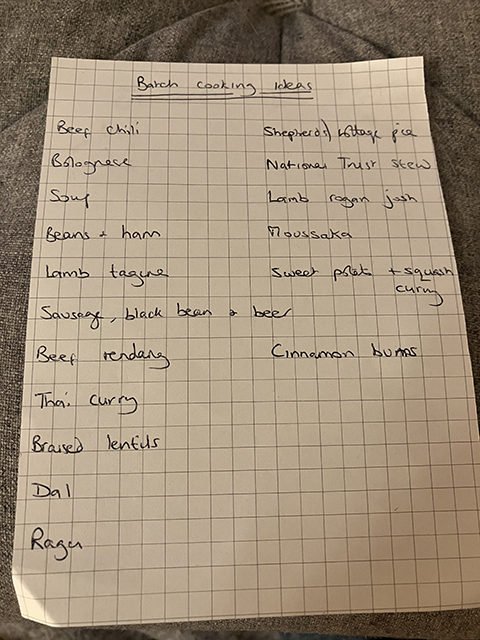
I like to keep at least three of these in the freezer at any one time, PLUS the ingredients to get another one going – there’s a mutton shoulder that’s crying out to be turned into a rogan josh, and packets of beans asking to be soaked and joined in the pot with something of a porcine nature.
I like to have sweet things in the freezer too, maybe some stewed apple ready for a pie, some cinnamon buns or a loaf.
Cooking really good food for the freezer takes time, effort, imagination and planning. It also takes, I suppose, a bit of knowledge, because it’s not particularly fashionable to shop, cook or eat this way anymore. It’s important to know what freezes well and what doesn’t, and of course you need to have space to freeze stuff and keep a good record of what you’ve got. Did I mention that I keep a list of everything in the freezer? It’s next to the kettle so we can see at a glance at breakfast time what might be on the menu for tea if I can’t be bothered to cook. It’s nerdy but essential.
Batch cooking is so deeply worth it. I strongly urge you to give it a try, if you don’t already.
Also this month: dear God, the weather! We’ve had snow, frost, wind, rain, sun and much else besides.


Cooking and eating: Apple, pear and quince sponge (quince and apple compote from the freezer, obviously); macaroni cheese with gruyere, cheddar and parmesan; gingerbread men; cranberry and orange loaf cake.
Allotment and garden: Planted out bare-root rose; checked the allotment after the storm and miraculously all the plastic mulch has stayed put, all credit to Matt’s installation skills; leaf clearing and general tidying after the snow.
Also: Read The Fat of the Land by John Seymour, a brilliant 1959 tome about self-sufficiency in Suffolk by the man who (I think) inspired The Good Life. Definitely worth a read by anyone interested in food production, farming, rural life and mid-century living.
Love the batch cooking list – really want to know what National Trust stew is ? 😊
Thanks Callie! National Trust stew is my name for a stew that’s got a little bit of meat in it (venison, steak) but it 85% root veg. Carrots, parsnips, turnip, squash, that kind of thing. Makes a very little go a very long way, and still feels really comforting and nourishing.