Declaring war on weeds

What a glorious weekend! This was the view from British Camp on Saturday. Not quite coats-off weather, but nearly.

2015-03-21 14.40.32

British Camp, Malvern Hills

The warmer weather is causing sap to rise. Not just in the plants – there are buds forming and seedlings making their presence known – but also in the humans. Sunshine provokes activity, and I have had it with the weeds. The giant tufts of grass, the wispy mess of straw, the decayed bind weed – we’ll never totally win the battle, but I can make in-roads.

So, with the sun on our backs, the raspberries have been reclaimed from grass, buttercups and bindweeds. Some of the grass was so heavy I couldn’t physically lift it – there is some satisfaction in knowing that it’s now smouldering on the fire.

In an unexpected pay-off, with its choking weed blanket removed, I discovered that the rhubarb we inherited is actually very established and shooting. I’ve covered it with protective straw and crossed fingers for a summer resurgence. The next job is to mulch ALL the soft fruit so that the grass can never establish itself again.

2015-03-22 17.01.07

Raspberries cleaned, rhubarb straw-ed

2015-03-22 15.36.35

Burning up 18 months of organic waste

The broad beans haven’t wintered so well, with only six remaining. So I’ve direct sown three rows more, with a mental note to protect them against the birds in the next week or so.

2015-03-22 15.36.57

Sowing new broad beans with the over-wintered seedlings

And Matt got out his tools and re-felted the shed roof, a job that I wouldn’t have even noticed needs doing until the whole structure had collapsed. * This is why we’re a good team. *

2015-03-22 17.04.32

Roof repairs

Spring cleaning and direct sowing: the new year has properly begun.

Planted: broad beans

Hot not-cross bun loaf

It’s not quite Easter, but time nonetheless for a hot cross bun. But I’ve been lusting after a more childish teatime treat, the Belgian bun, where you get icing all over your fingers. So what if I combined the two? And just made a massive bun-loaf rather than fiddle around with individual ones? And so is born the hot not-cross bun loaf.

I adapted the basic hot cross bun recipe from the River Cottage Year, which is turn derived from Margaret Costa’s 1960 recipe.

Start by making a sponge or starter dough. Dried yeast is soaked in a mixture of hot water, cold milk and sugar until it froths and foams.

2015-03-19 11.01.22

Foaming yeast

This is then mixed with plain (not strong) flour into a sloppy batter and left for 45 minutes to ferment.

Beat the yeast mixture into plain flour and leave to ferment

The sponge will double in size and become full of honeycombed bubbles, like the kind you’d find in a crumpet. After 45 minutes it looked like this:

Fermented sponge

In the meantime, I soaked some dried fruit in hot water, with a teabag thrown in for flavour. This is a really old-fashioned technique, usually used to make tea-breads (hence the name). It makes cheap fruit nice and plump.

Next, the fermented sponge is topped up with more flour, the drained fruit, sugar, melted butter, egg and flavoured with mixed spice, cinnamon and orange zest.

It’s beaten together for a few minutes – the original recipe said that the dough would be ‘workable’, which I translate as ‘sloppy’. This is one to be worked in the bowl rather than the worktop – I used a wooden spoon. It’s made with plain flour, meaning there is no gluten, so I was just looking to bring it together well rather than achieve a spongy bread-type dough.

All mixed and ready to prove

It’s then left again for an hour to prove, where it easily doubled in size. At this point it can be shaped into buns but rather than do that, I simply roughly shaped the dough into a ball and then slopped it into a non-stick spring-form pan – slopped is the only word, this is a WET dough. Leave for another 15 minutes, then brush with beaten egg.

2015-03-19 13.48.13

Ready to bake

I baked the bun-loaf at 200c for 20 minutes, then glazed again with more egg and baked for a further 25 minutes at 180c. Once cooled, I drizzled the bun-loaf with a basic glace icing. This is LOTS easier than making crosses in a traditional hot-cross bun.

2015-03-19 16.07.22

Hot not-cross bun loaf

2015-03-19 16.18.01

On the inside – fruity, cinnamon-y and sweet

The verdict: It’s lovely and fruity, with a good taste of cinnamon and orange. I’m intrigued by yeast-based recipes which use plain rather than strong flour: this one makes a light bun but still has a texture verging on cake – next time I might try and use half plain flour / half strong. There’s no residual taste of yeast, which is pleasing. A great option for teatime or breakfast.

Hot Not-Cross Bun Loaf

Adapted from The River Cottage Year

500g plain flour

125ml milk, cold from the fridge

125ml boiling water plus extra to soak fruit

10g dried yeast

125g dried mixed fruit

1 teabag

50g caster sugar, plus 1 tsp

Half tsp fine salt

1 tsp ground mixed spice

1 tsp ground cinnamon

zest of 1 orange

50 melted butter

1 egg, beaten

For the glaze:

2 tblsp icing sugar

boiling water

Divide the flour into two separate bowls. Soak the yeast in the milk and water with a teaspoon of sugar. Leave until frothy and foaming. Mix yeast mixture into one of the bowls of flour, cover and leave to ferment for 45 minutes.

Meanwhile, soak the fruit in boiling water and a teabag. Add the sugar, spice, salt and zest to the remaining flour.

Once the starter is risen and clearly active, add the dry ingredients along with half the egg and the melted butter. Drain the fruit and add that in. Beat to a smooth dough – I used a wooden spoon. Cover and prove for an hour, until doubled in size.

Pre-heat oven to 200c and grease a spring-form tin. Shape the dough into a round and transfer to the tin. Prove for another 20 minutes, then glaze with remaining egg.

Bake for 15 minutes, glaze again, then bake at 180c until done – another 2o minutes. Leave to cool. Mix sugar with boiling water to make a thick glace icing. Drizzle on top of the bun loaf.

Catkins and cowslips

There are bird wars outside our bedroom window. Our neighbour’s trees – way over-sized at about 50 feet tall – are now home to precariously balanced nests, still in construction. I think they are crows, possibly jackdaws, and for the past few mornings there have been altercations as one bird harries another away from the building site. He swoops over the road with his black feathers glinting and the magpies look on, bobbing away on branches.

We went to Bucks today, just 90 minutes south, but already a few weeks ahead in terms of blossoms and blooms. On the service station near Bicester, more birds (crows? jackdaws?) were building their dens. Five minutes later I spied catkins in the car park.

2015-03-17 12.38.55

M40 springtime catkins

Then in Marlow, primroses and – unbelievable – cowslips! But on reflection, I like that Birmingham’s springtime is later. It is pleasure doubled: we see the blooms arrive in the south, then come home and experience it all over again. The joys of delayed gratification.

And speaking of gratification – the Marlow trip was to visit The Hand and Flowers, the Michelin star gastro-pub famous for its duck-fat chips and laid back atmosphere. I’ve been ill for the last few days but booked this table back in November, so WE WERE GOING. And what did I find on the menu but a posh custard slice – brilliantly executed, with crumbly shards of pastry held together with apple puree and pastry cream – but not a patch on those solid wedges from Cooks Bakery in Upton which I wrote about the other day.


Flapjacks with sour cherry, coconut and white chocolate

Way back when, whilst doing my A Levels, I had a Saturday job at Cooks Bakery in Upton Upon Severn. Cooks is one of those old-fashioned bakeries, very few left now, selling viennese fingers, jam doughnuts, iced buns and florentines. When I was little, my Nan would take me there for a custard slice. I would slice the slab of solidified yellow custard in half horizontally to make two open-sandwiches of puff pastry and custard, saving the one that was smothered in white glace icing until last. I still love a custard slice.

Other highlights of a day’s work at Cooks included the apple and almond slice (pastry topped with a layer of stewed apple and frangipane), the big white tin loaves (this was the time of the white-sliced, so an actual loaf of whole bread was a MAJOR treat) and the flapjacks.

The baker, Mr Russell, always put a handful of coconut into his flapjacks. Not enough to make it discernibly coconutty, but just enough to give an intriguing twist of flavours. I still do this now, but like to chuck in new-fangled things such as dried sour cherries and white chocolate.

Everytime I make flapjacks, I think of my time at Cooks: the striped pinny, the smell of vanilla and that hideous day when I unknowingly sold a dummy porkpie stuffed with newspaper. I didn’t realise it then, but what idyllic days they were.

Back to the flapjacks. Any idiot can do this: melt syrup, butter and sugar together, and mix into rolled oats and coconut.

2015-03-12 09.58.50

Melt brown sugar, butter and syrup together

2015-03-12 09.57.53

Oats, coconut and dried sour cherries

I like to sandwich the chocolate between layers of flapjack mixture. This helps to stop the chocolate catching and burning in the oven. I have used white today, but plain chocolate is also excellent.

2015-03-12 09.57.36

White chocolate chopped into chunks

Bake on parchment paper and remember to slice when still warm and pliable.

2015-03-12 10.51.06

Bake for 20 minutes and ta da!

Flapjacks

100g butter

100g light soft brown sugar

75g golden syrup

200g rolled oats

25g desiccated coconut

handful dried cherries or other fruit

50g white chocolate, chopped

Preheat oven to 180c and line a suitable baking dish with parchment paper.

Melt together butter, syrup and sugar over a gentle heat. Leave to cool slightly whilst you measure out the oats, coconut and fruit into a bowl. Prepare the chocolate and leave to one side for now.

Stir the butter mixture with the oat mixture until well combined. Tip about a third into the prepared dish, sprinkle the chocolate on top, then finish with the remaining mixture. Doing this keeps the chocolate covered, which helps prevent it burning in the oven.

Bake for about 20 minutes until golden and bubbling. Keep an eye on it, over-done flapjacks are not good at all. Cool for 15 minutes or so in the dish then remove the parchment paper and slice the flapjacks. Leave to cool completely.

More seeds: leeks, sunflowers, early salads

After Saturday’s sunshine, yesterday was a washout. Pity, as we’ve now lost the momentum of weeding and tidying (Matt was going to re-felt the shed yesterday). According to Gardener’s World I should be mulching my autumn raspberries to keep the weeds at bay: another thing to add to the list.

In the meantime, I spent a rainy Sunday afternoon starting more things off: leeks, chillies, winter lettuce, viola, sunflowers, lemon balm, radish, cat-nip, hyssop, parsley and coriander. All are now precariously balanced on windowsills, lodged in place by appropriately sized books – I wonder how long they will last until the cat sends them all flying. (I don’t have much hope for the radish but last year’s, planted directly outside, were terrible. This lot are experimental to see if an indoor start in finer compost makes a difference.)

2015-03-08 17.15.18

Balanced seed tray

Meanwhile last year’s amaryllis is in bloom again. Bulbs are such a miracle: that so much life can be contained in such an unpromising papery shell.

2015-03-09 09.36.37

Amaryllis in bloom

This morning I flipped over a postcard which I saved from the first amazingly warm spring weekend of 2014. I was in Sussex on a yoga retreat, surrounded by singing birds, bobbing daffodils, catkins and primrose. Turned out that it was a year ago today! That weekend marked the true start of the calendar year for me. March, the month of hope and new beginnings.

Planted for windowsills: Sunflowers, viola, winter lettuce mix, cayenne chilli, hyssop, parsley, coriander, radish, cat-nip, leeks, lemon balm.

The early March allotment

We were in London last weekend. At Tate Britain I coveted a Barbara Hepworth sculpture, reminiscent of the turning waves on the Cornish sea…and also wondered why it’s taken so long for her to get a major exhibition at Tate when Henry Moore has his own room (a Hepworth retrospective is due this summer).

2015-02-27 13.14.18

Hepworth sculpture

2015-02-27 12.47.33

Tate Britain

The Botanical Art Exhibition at the RHS’s Pimlico halls was fun. Being the RHS, even the table decorations were stunning.

2015-02-27 14.55.41

Table decoration at the RHS Langley Hall

Then over in Walthamstow, the William Morris Gallery made for an inspiring Saturday afternoon visit. The Arts and Crafts textile and wallpaper designs endure with timeless style.

2015-02-28 14.07.51

William Morris Gallery

Back in Birmingham – a relief after all the hustle (and hipsters) of Shoreditch – the seasons are changing. The daffodils in the communal front garden-wilderness have popped open this week, with their welcoming flashes of yellow. So too the crocus, with their jazzy flashes of purple and orange.

2015-03-04 10.37.04

Jug of daffodils

2015-03-07 12.18.02

Crocus in bloom

Today was a properly warm day, about 12c I think, with blue skies and a slight breeze. We spent a couple of hours this afternoon on the allotment basking in the unexpected sunshine, checking on progress and beginning the spring clean.

2015-03-07 15.06.16

The view on 7 March

Seven broad beans have survived the winter bombardment of rain and wind, just as they did last year. They are hardy buggers, although looking a bit sad. These will provide the first crop but I’ll put in further seedlings for a second cutting later in the spring.

2015-03-07 15.07.00

Baby broad bean

The gooseberry has finally been moved, away from the choking weeds of the autumn raspberries, to a new home next to the blueberries and currants. It’s replacing those blackberries that Matt took out last autumn.

2015-03-07 16.06.36

The moved gooseberry

And speaking of those choking weeds, I made a start of clearing those massive tufts of grass from the large raspberry patch. It took about an hour to do a third, so actually it will be a swift job, but my God it was hard work. Particularly as I’ve had physio on that dodgy left shoulder this week. Need to take it slow and steady.

2015-03-07 16.28.41

It may look like nothing but this patch of cleared earth is a patch of hope

Matt cleared out all the crap from the back of the greenhouse, piling it up for what will be an epic bonfire. Amidst the rotten scaffolding planks was plastic detritus, the stuff that makes my skin crawl, which will have to go to the tip. Spring cleaning has begun.

2015-03-07 16.32.48

Starting to clear back of the greenhouse by the stream

Moved: gooseberry

Weeded: started large raspberry patch

Harvested: rosemary, sage

Tidied up: sage, marjoram, rocket

Seeds are here, tomatoes are in

My friend and work-mate Antonia had a mooch around the allotments at the weekend with a view to taking one on. It was good to see what the neighbours are up to. There’s a lot of potato activity going on – trenches everywhere – and great mounds of manure ready for spreading. Archie the allotment-boss was in his office-shed as normal, surrounded by piles of potatoes protected under wool blankets. There are snowdrops out and the daffodils are on their way. Spring won’t be long now.

The seeds are here! I started the tomatoes off yesterday along with some basil. In a week or so I’ll sow some catnip for Gertie, which will hopefully prevent her nibbling on the sweet pea seedlings.

2015-02-25 11.22.24

Seeds! Seeds!

All the seed trays needed a good scrub. No outdoor water supply here so they’ve had to go in the bath instead, dead wasps, snails and all.

2015-02-21 15.02.10

Seed trays are all scrubbed

I’ve sowed the tomatoes about two weeks earlier than last year and it will be interesting to see if this has any effect on the crop. Soon every windowsill in the flat will have seed trays balanced on them.

2015-02-25 18.58.40

Tomates are sowed. This year I’ve actually labelled them so should have a vague idea of what is what.

2015-02-25 18.58.58

But somebody had a different idea about labelling

Chocolate-hazelnut couronne

Occasionally a magazine will come up with an image so brilliantly filthy that the recipe begs to be cooked. Such is this, from the February issue of Waitrose Kitchen. A bread stuffed with posh home-made Nutella? Yes. Please.
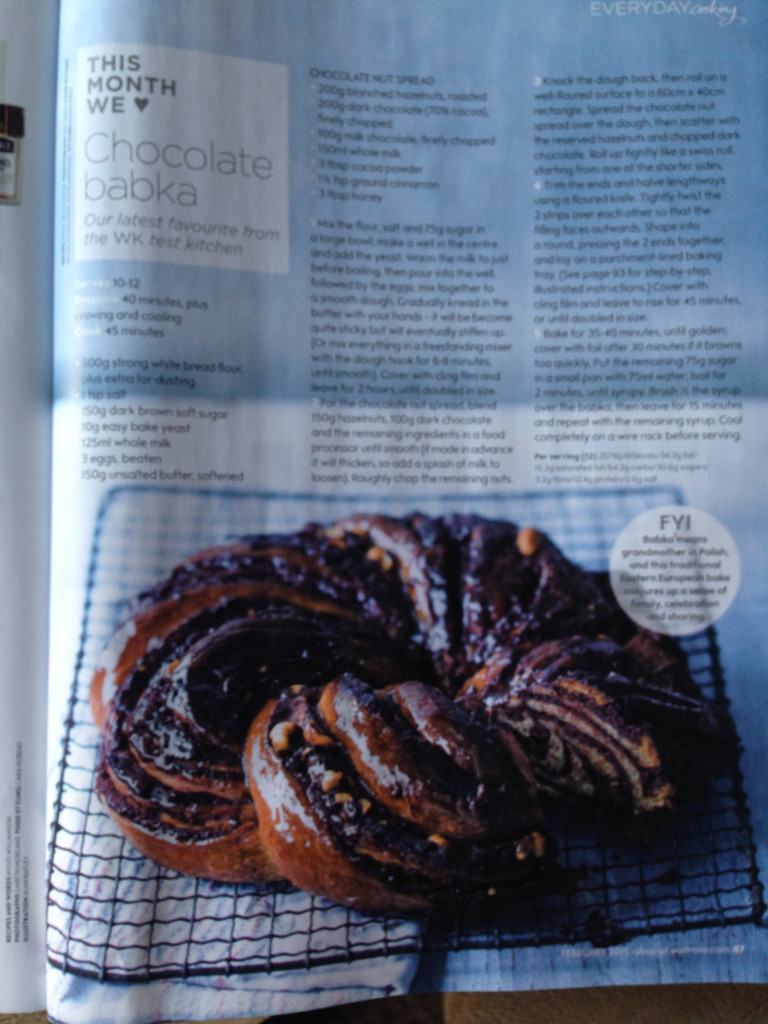
2015-02-21 15.18.03

The original

They’ve called this a babka, which is a traditional Polish enriched bread, stuffed with nuts and cocoa then folded four times into a tin to make a giant loaf. It was featured on last year’s Bake Off, when all the contestants messed it up by baking for too short a time. I’m pretty sure that babka has Jewish roots…I’ve made a mental note to research that properly.

This recipe is clearly not that. The flavours might be the same, but there is none of that tricky folding and shaping. It’s more like a couronne, a French twisted crown-loaf. So that’s what I’m calling it.

First up, make an enriched dough. This one has milk, butter, eggs and a touch of dark brown sugar. The recipe said to use some easy bake yeast but I had fresh in the fridge, so that’s what I used. It’s a soft dough but not impossibly so, and came together easily enough. I worked it by hand for about five minutes (I use the Richard Bertinet technique) and then left it for a good two hours to rise.
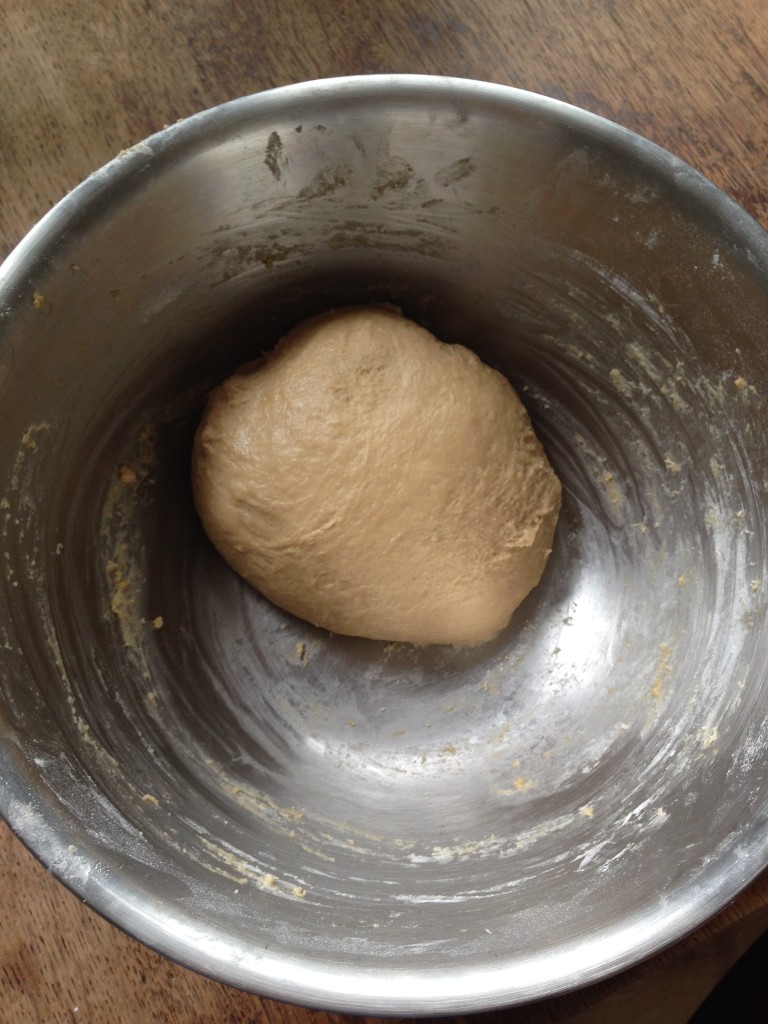
2015-02-21 10.51.25

The worked dough prior to its rise

Whilst it’s rising, make up the chocolate nut filling. The recipe said to use a mixture of 70% dark and milk chocolate, but I used regular dark chocolate (Bournville-type). It gets whizzed up in the food processor with whole hazelnuts, cocoa, honey, milk and cinnamon. It comes together into a spreadable paste, like chunky Nutella, but loads better. If you were so-inclined, a bit of orange zest might be a nice addition here.

2015-02-21 13.27.25

The chocolate-nut mixture

Now the fun bit! The dough needs rolling out, filling and rolling. The recipe said to roll it 60cm x 40cm, which is the kind of instruction I read without ever actually comprehending. Matt, the human-calculator, happened to be around so told me how big this actually is: “roll it bigger than your biggest chopping board”. So that’s what I did.
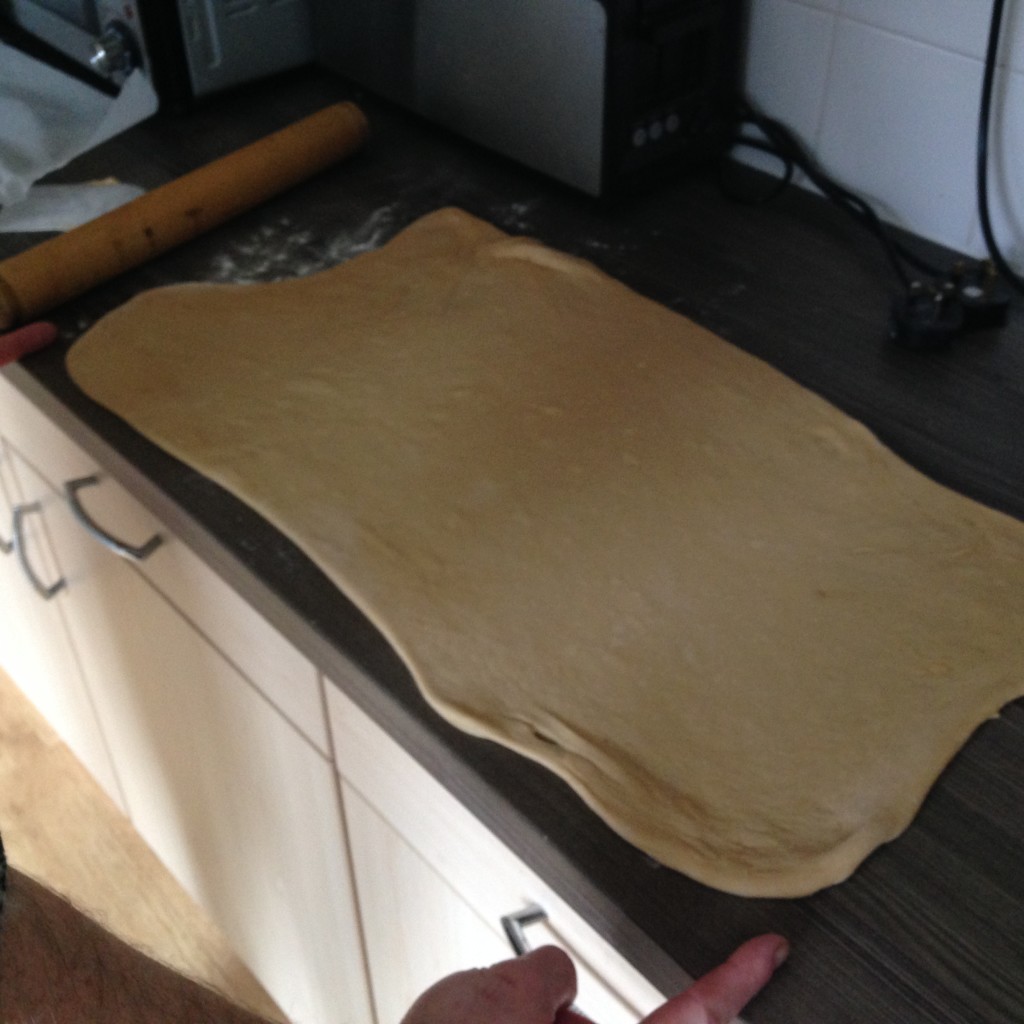
2015-02-21 13.28.53

It helps if someone tells you how far to roll

Then the chocolate mixture goes on top. It was freshly made and spread easily…if made in advance it might get too thick, in which case a drop of hot water should sort it out.
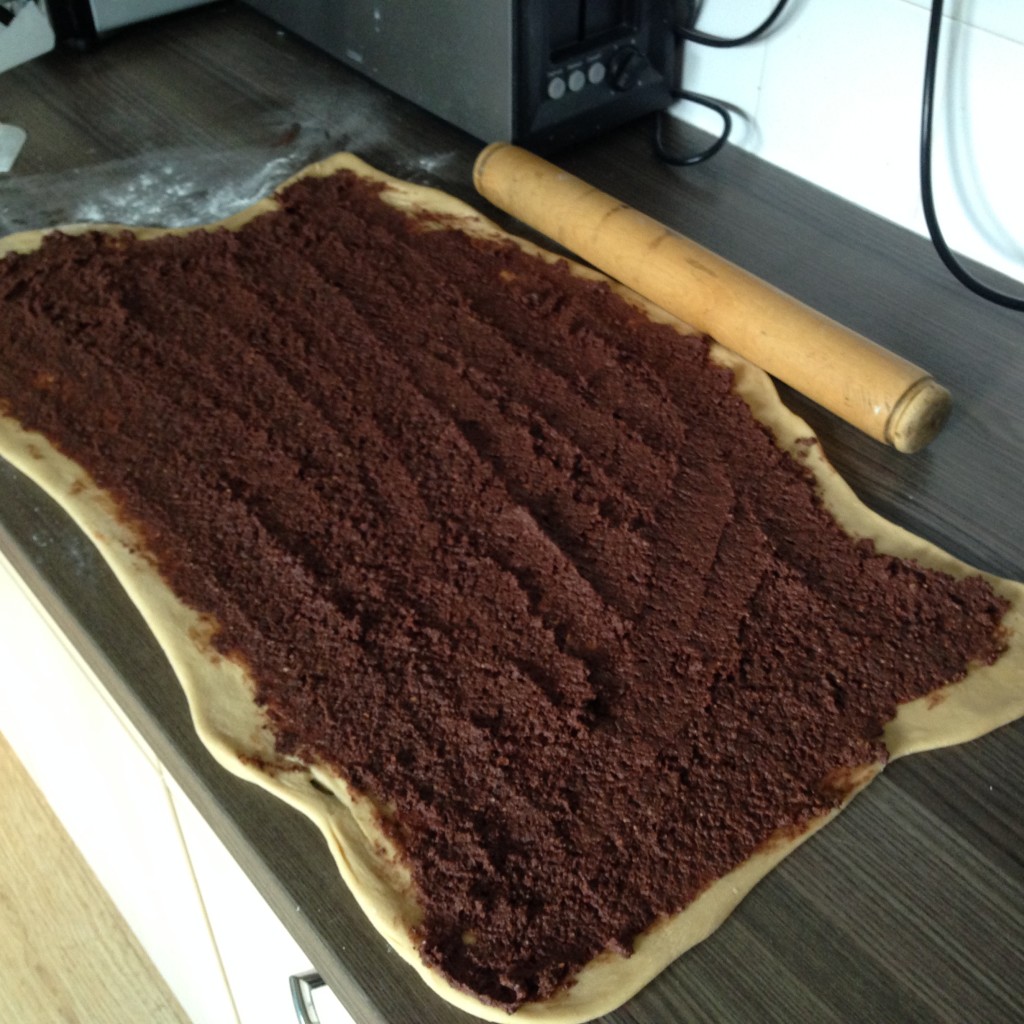
2015-02-21 13.32.33

Spread the chocolate filling evenly on the top

Then it gets rolled up from the shorter end. Mine was a bit wonky, but it didn’t seem to matter too much.

2015-02-21 13.34.55

Roll up into a swiss-roll, working from the short end.

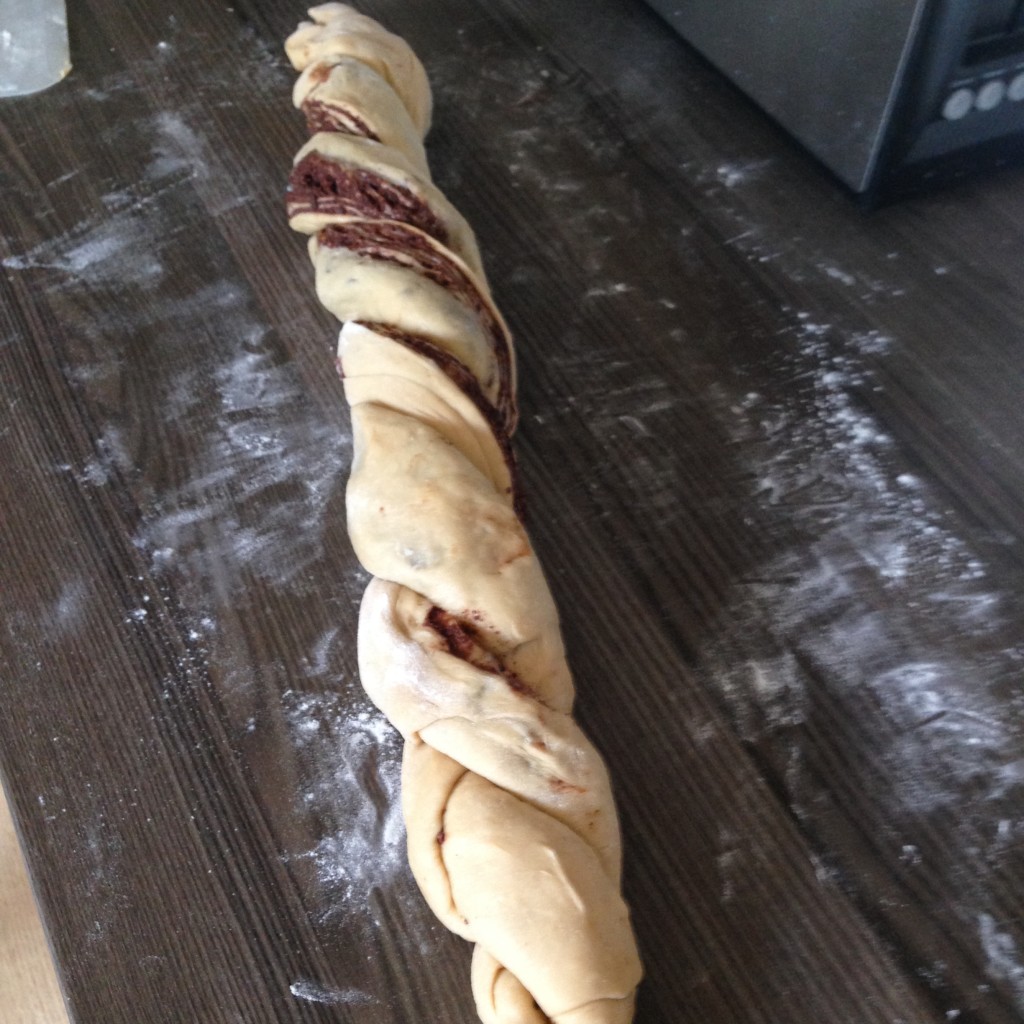
I then sliced it in half length-ways, using a metal scraper. The two halves then get twisted around each other, as tightly as is possible without losing all the filling.
2015-02-21 13.36.14

Slice in half then twist the two pieces around each other

Next, shape it into a circle, tuck the ends under and pop it onto baking parchment on a baking sheet. Cover (I use a linen cloth but you could use plastic film) and leave to prove again – this one took 45 minutes. It won’t grow that much in size, but will get nicely puffy and if you gently prod it, the indentation from your finger should stay put.

2015-02-21 13.36.58

Before the second prove

2015-02-21 14.22.36

After the second prove

Preheat the oven – the recipe failed to give a baking temperature so I put it in at 200c. It took 45 minutes, but I covered it in foil for the last ten minutes to stop too much browning. It still caught a bit, though I think with all that chocolate and sugar this might have been inevitable.

The last step is to glaze. Bubble up dark brown sugar and water until syrupy, then paint it on. It’s then left for a few minutes, then glazed again. The sugar makes it taste treacly, so if you prefer a more toffee flavour use light brown sugar instead. Leave until cool until serving.

2015-02-21 15.13.10

Out of the oven and glazed

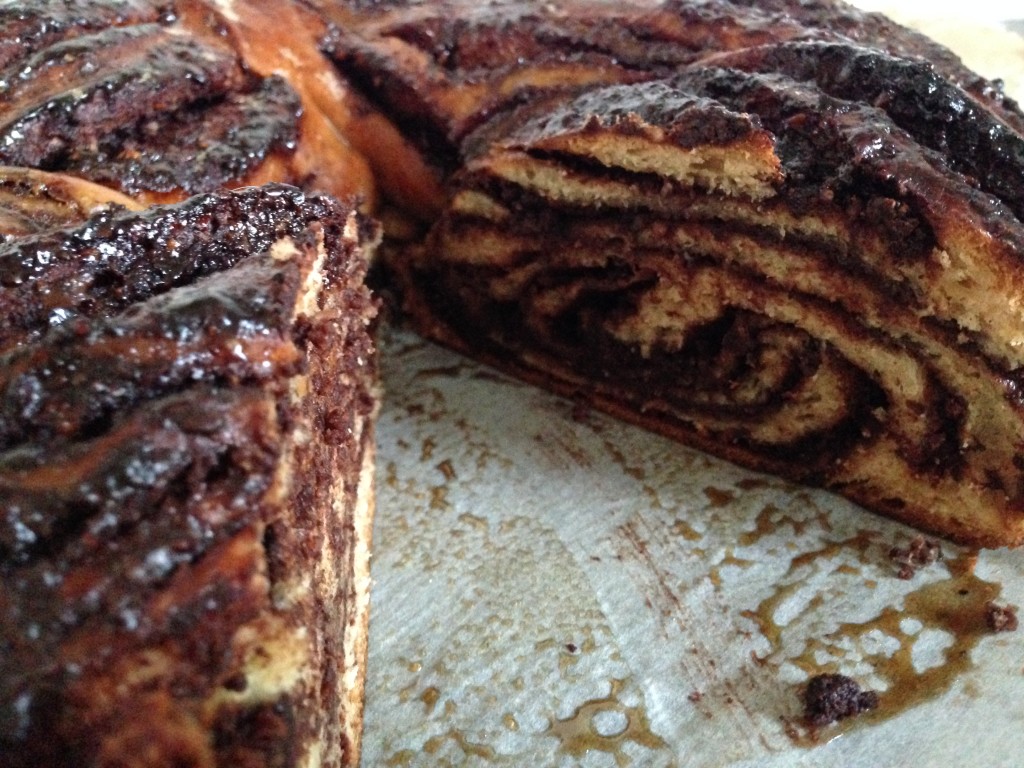
It’s really, really good. The layers of chocolate keep the dough really moist, but there’s a nice level of crust around the edge and chewiness in the middle. Plus it looks really impressive.

Now that I’ve given it a go, it’s ripe for experimentation: the same base recipe could be adapted with almonds, marzipan, fresh and dried fruit. A great offering for a gathering or party.
2015-02-21 16.31.54

All swirly in the middle

2015-02-21 16.31.37

Just a slice

Chocolate-hazelnut couronne

Adapted from Waitrose Kitchen, February 2015 edition, p87

For the dough:

500g strong white flour

10g salt

75g dark brown sugar

15g fresh yeast or 10g easy blend yeast

125ml milk

3 eggs, beaten

150g butter

For the filling:

150g whole hazelnuts

150g dark chocolate (Bournville-type)

150ml milk

3tbsp cocoa

3tbsp runny honey

1tsp cinnamon

For the glaze:

75g dark or light brown sugar

75ml water

For the dough: Mix salt into the flour and sugar. Crumble in fresh yeast. Warm butter and milk together, add to dry ingredients with eggs. Mix to a soft dough and knead  until smooth and springy. Cover with linen cloth or plastic film, leave to prove for two hours.

For the filling: Chop nuts and chocolate in food processor, add everything else and whizz to a paste.

Very lightly flour the work surface. Roll the dough into a rectangle 60cm x 40cm – the long end should be twice the length of a long ruler. Spread the filling evenly on top. Roll up from the short end, using a plastic scraper to help. Smooth the roll out into a long sausage shape. Using a sharp non-serrated knife or metal scraper, slice it in two lengthways. Twist the two lengths together and draw them together into a circle, tucking in the ends. Transfer to a baking tray lined with baking parchment. Cover again and leave to prove for 45 minutes.

Preheat oven to 200c. Bake for 45 minutes, covering with foil after 25 minutes to stop it browning too much. Make a glaze by bubbling sugar and water together for five minutes or so. Glaze the couronne when it’s fresh from the oven, leave for  five minutes then glaze again. Cool before eating.

Apple crumble muffin cake

The search for the perfect curry continues. Jyoti’s has been on the ‘must visit’ list for ages: it’s family-run, Hindu and completely vegetarian.

2015-02-18 19.21.52

Jyoti’s Vegetarian

After years of research, I think vegetarian Indian food is (whisper it) better than meat-based. It tends to be lighter, which makes the flavours sing and the dishes are generally less heavy going. But it’s surprisingly hard to find a decent veggie selection in many restaurants, presumably because most are Bangladeshi and vegetarianism isn’t so great a part of the culture there.

Not so at Jyoti’s, where the vegetable and the legume are king. The food tastes like proper home-cooking, is incredibly cheap (£12 for a three course meal) and knocks the socks off pretty much everything else I’ve tried in the city. Love Jyoti’s.

2015-02-18 20.36.37

Chickpea and spinach curry, chapati and yoghurt

I’ve been making experimental muffins this week, getting through some of the fruit that’s been hanging around. Apple crumble muffin cake anyone? It’s a basic muffin mix with chopped Cox apple, spiked with cinnamon and baked with a handful of crumble on the top.

2015-02-20 11.16.14

Apple crumble muffin cake, ready for baking 

2015-02-20 11.59.59

…and after baking. The crumble has merged into the cake, giving a crunchy topping.

I baked two apple crumble mini-loaves and then used leftover batter to make muffins, this time with a dollop of raspberry compote in the middle. A really easy way to get something sweet and fruity in next to no time.

2015-02-20 11.16.20

Raspberry compote muffins, before baking

2015-02-20 11.59.35

And fresh from the oven

The same base mixture could be flavoured with pretty much anything, and will reliably come up with decent muffins or a lovely moist large cake. Blueberries, blackberries, strawberries, dried fruit, chocolate chunks…it’s never failed me yet.

Fruity muffins

Basic muffin mixture:

110g self raising flour

150g plain flour

2tsp baking powder

175g caster sugar

50g light brown sugar

110g butter

225ml milk

2 eggs

Preheat oven to 180c and line your tins. This mixture will make either 12 muffins, one 7-inch round cake, one 2lb loaf cake or four mini loaves.

Put all the dry ingredients into a bowl and mix together briefly to combine (get rid of any sugary lumps with your fingers). Melt the butter into the milk (I use the microwave) and when it is hand-hot, add to the dry ingredients. Use a wooden spoon or electric mixer to bring it together into a smooth, quite liquid batter. Beat the eggs with a fork and add to the mix, beating until just combined. Add your chosen fillings at this point. Pour into the waiting muffin cases or tins and bake. Muffins will take about 25 minutes, mini-loaves about 30 minutes, large loaf or round tin up to 1 hour.

For apple crumble muffins: Peel, core and dice two Cox apples, shake over a little cinnamon to flavour. Make a crumble by rubbing 50g butter into 100g plain flour then stir in 50g caster sugar. Stir apple into the basic muffin mix, pour into the cases or tins. Top with a sprinkling of crumble, bake.

For fruity compote muffins: Make a simple compote with raspberries, blueberries, blackcurrants or blackberries by heating a handful of fruit over a medium heat with a spoonful of sugar and drop of water. Cook for five minutes until syrupy, cool. Fill muffin cases half-way with basic muffin mix, top with a spoonful of compote, top with remaining mix. Sprinkle demerara sugar on each muffin, bake.


Rhubarb bellini

Forced rhubarb is in the shops right now, so it’s time for a seasonal treat: rhubarb bellini. Booze and fruit, what’s not to love? And yes, I know that technically rhubarb is a vegetable. Or is it a herb? It’s part of the sorrel family, so who knows.

I used to make these cocktails as an after-thought when I’d cooked up some rhubarb for a compote, but they are now a favourite and I’ve been known to hunt out the pink stems specifically to be baked and then drenched in fizz. You use the syrup rather than the actual fruit, so save the leftovers for another recipe.

These bellini are only worth making at this time of year when the forced rhubarb is in season. They are prettily, delicately pink, but the rhubarb gives a good punch of flavour. I suppose you could try using the thick, green, late summer rhubarb, but it might be a bit too, well, rhubarby. This recipe is also a great way of making less-than-brilliant wine a bit more drinkable. I like to use cava as it’s not too sweet, but prosecco would also be fine.

No quantities for this: use as much rhubarb as you have and as much sugar or honey as feels right for your tastes.

Rhubarb bellini

Forced rhubarb

Sugar or honey

Water

Prosecco, cava or sparkling wine, chilled

Preheat the oven to 180c. Trim the rhubarb into inch-long lengths and tumble them into a baking dish. Drizzle on a little honey or sugar and a splash of water.  Bake for about 10 minutes until the rhubarb is softened and the juices are running.

2015-02-15 18.21.30

Baked rhubarb ready to be drained of syrup

Drain off the pink watery syrup and chill it thoroughly – set the fruit aside and use for another recipe. When the syrup is properly cold, spoon a little into the base of a champagne class and slowly top up with your fizz – if you pour too quickly the sugars react and you’ll have a frothy mess on your hands. Enjoy.

2015-02-15 18.22.36

Pink fizz