Sloe gin

So, about a month earlier than normal, I get down to making the sloe gin. It’s a maceration and easy as anything, especially if you freeze the sloes first. The books say this is to mimic the frost and breakdown the skins – that may or may not be true, but what IS true (and convenient) is they can hang out on ice whilst you faff around finding some gin, jars, and all the rest of it.

2014-09-15 09.29.56

1lb of perfect Worcestershire sloes, from the freezer

Sloe Gin

500g sloes, frozen if you like, or fresh. Just make sure they are clean, with no bugs, rot, leaves or stalk.

1litre gin (or vodka)

225g sugar

Just put the lot in a clean jar and stir around a bit. Ta da, that’s it! Leave for a few months, as little as three or as long as six. For the first week or so you’ll need to shake the jar every day to help dissolve the sugar. Apparently the longer you leave it, the more likely you are to get notes of almond into your gin from the sloe kernel.

Then strain (chuck the sloes, they are disgusting) and bottle. The longer you leave it in the bottle before drinking, the better it is. I’m not talking months, I’m talking years.

2014-09-16 16.17.53

2014 vintage sloe gin

Sweet chilli sauce

I’ve had to use up all those chillies from Mother’s greenhouse – 32, to be precise. Sweet chilli sauce it is.

2014-09-12 18.38.34

32 chillies waiting to be cooked up


I use a recipe from a great little paperback, Thai Cookery Secrets by Kris Dhillon. There’s no pictures, no styling, just clear instructions for all things Thai. I’ve altered the quantities in order to deal with the chilli glut and also added a little thickener, and so we need (original recipe in brackets):

32 (6) red chillies, green tops removed

40 (8) cloves of garlic, peeled

750ml (250ml) white vinegar (I use a mixture of white wine and rice, but only because that’s what I had)

750ml (250ml)  granulated sugar

1tbsp cornflour, slaked with a little water

5 (1) tbsp fresh lime juice

5 (1) tbsp fish sauce

Once you’ve gone through the lengthy steps of prepping all the chilli and garlic, put them in the food processor and whizz until finely chopped. Then simply pop it into quite a large pan along with the sugar and vinegar. It will look like this:

2014-09-12 19.18.54

Before cooking


Stir on a gentle heat until the sugar is dissolved, then put up the temperature and cook until syrupy. How long this takes depends on the quantities involved, but this vat took about 40 minutes (I cooked mine until the sugar thermometer read 110 celsius). Whatever you do, do not make the mistake of breathing in the chilli-vinegar fumes that will come off your saucepan, as you may never recover. I never, ever learn this lesson. You might want to open some windows and get the extractor fan on.

When it’s nearly ready, add a little of the slaked cornflour and cook it through until you have the consistency that you’re after – I tested by popping a little onto a saucer and leaving to cool a little. You want something that is still liquid but with some viscosity, like runny honey. When it’s done, take the pan off the heat.

I bottled this lot, leaving it to cool for half an hour and then pouring into sterilised jars. The sauce keeps pretty well but it’s best to leave it for a week or so before eating, to allow the vinegar to mellow.

2014-09-13 10.07.32

Sweet chilli sauce


Taking it sloe

Last week I mentioned that I’d heard news of a sloe disaster. A sloe emergency, if you will. Shrivelling sloes. In September! This is baaaaad news. Usually I am late with my sloe picking, and that’s at the end of October. But to have them going over at the start of September? Well, that’s just nature turned on its head. Autumn is weeks early this year.

So to the shire for a morning of seasonal hunter gathering. First up, apples and pears. There’s only one place to go, Clives Fruit Farm. I love Clives. This is a farm shop in the old fashioned sense, with huge bins of fruit, chooks running around, and a few old men sporting overalls and boots that have possibly been in use since the 1940s.

2014-09-13 11.50.02

Don’t chase the chickens

2014-09-13 11.51.51

A few bins of their own fruit

2014-09-13 11.55.48

Wobblyjuice

I leave with plums, bramleys, some other apples that I’ve never heard of, cider, bacon, pork, beef…it’s all good.

Next up: sloes.

Over the years I have had to learn the art of protecting oneself against the wickedness that is the blackthorn tree. This is one spiky bugger. There are three essential bits of kit: wellies, leather hat, leather gloves. Of these, the most important is the wellies – not for protection against mud, but against brambles that come up to the knees. Long sleeves are a given. You might look like an idiot, but better that than a scored arm. Though actually I love dressing up in my yokel country clothes.

2014-09-13 12.29.46

Essential sloe gathering kit

2014-09-13 12.45.12

This is why the kit is needed

The berries are abundant this year and I’ve come home with a trugful of fat, round sloes with a special bonus picking of blackberries. To be in amongst the brambles and grasses, with the sweet scent of autumn in the air…this is the essence of living.

Only a fool discloses their special place for foraging so suffice to say that I was near a hill, could hear the sheep having a chat amongst themselves and also the geese who appeared to be losing their minds at the dogs on walkies.

I was right to go out now – some of these sloes are already going over. The effects of an early spring, hot summer, dry early autumn combine, and in a week’s time they will be gone.

2014-09-13 13.09.35

Some are already rotting on the bough

2014-09-13 12.57.19

Thistles turning into cotton candy

2014-09-13 12.39.38

Bonus pickings

2014-09-13 13.00.30

Old man’s beard

I’m not a particularly patient picker and usually give up far earlier than perhaps I should. But today was a good picking. Next up: sloe gin.

2014-09-13 13.14.27

The trug full

2014-09-13 16.38.05

The day’s haul

An autumn loaf

Gertie has changed from a tiny ball of fluff into a slightly bigger ball of badness. Today she discovered the dustpan and brush, which as it turns out is the perfect size for a mid-morning kitten nap. Who knew?

2014-09-08 10.59.17

Last week I did one of those soul-destroying visits to Morrisons, the kind that make you grateful that you don’t go every week (one major bonus of having an allotment). It is quite incredible that some of the finest brains in retail have produced a shopping experience that is so uniquely energy sapping. Yet in their defence, on that visit they came up trumps: fresh yeast, hidden next to the butter, at the bargain price of 50p for 200g. That’s about enough for, what, 10 loaves? Best get baking.

2014-09-08 09.35.31

Fresh yeast

Fresh yeast is by FAR the best stuff for bread. The dried stuff is all very clean and efficient but always ends up tasting, well, yeasty. Fresh yeast is a different beast altogether, with a complex depth of flavour. It’s also easy as pie to use. None of that messing around with sugar and water and waiting for it to froth…just crumble it in the flour and you’re good to go.

It’s autumn so I thought I’d make a cider loaf (autumn…orchards…apples) but no cider in the house. What we do have is apple juice and lots of it, from Clives Fruit Farm in the Shire (Upton on Severn), squeezed from their own apples. This is a single variety Cox juice. Cider, apple juice, it’s all pretty much the same. I’d go for one that is dry-ish.

2014-09-08 09.36.35

Single variety apple juice from Clives, Upton on Severn

Cider wholemeal loaf:

250g strong wholemeal flour

250g strong white flour

10g fine sea salt

150ml milk

250ml dry cider or apple juice

25g fresh yeast

This is a recipe I’ve adapted from Nigel Slater’s Kitchen Diaries (he uses spelt flour and honey).

Put the salt at the bottom of a large bowl and add your flour on top – combine to mix. By doing this there is no chance of your salt killing the yeast. Next rub the yeast into the flour, just as if making a crumble.

Warm up the milk until when you put your finger in it, it feels neither warm nor cold, just wet. Good bit of advice that. Slosh it in, and then add the cider/juice. I do it in this order as if you mix the liquids in the jug the cider makes the milk separate into a claggy mess.

2014-09-08 09.39.23

Slosh it all in

Mix together with a scraper and then tip out onto your work surface and knead. I use the Bertinet technique (google: Richard Bertinet) which I won’t repeat here, only to say that it will make you a good baker of bread. After a few minutes you will go from having a wet mass of stodge into a springy bouncy ball of dough. Shape it into a round and place it back in your mixing bowl.
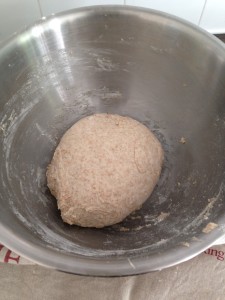
2014-09-08 09.48.16

Kneaded!


Place a cloth on the bowl and leave for about an hour or until roughly doubled in size. The milk and cider means that it may take longer to rise. That’s OK, just be patient.
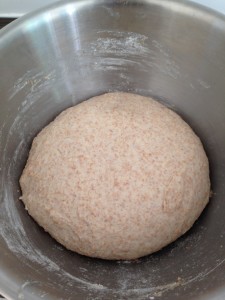
2014-09-08 10.58.28

Risen!


I like this bread shaped into a round, so I use a proving basket for the second rise. Turn out your dough onto a lightly floured work surface, shape it, and then place presentation-side-up down in the basket. Dough has to be properly shaped with a ‘backbone’ to give it the structure it needs to rise properly. Just google Bertinet, he’ll tell you everything you need to know.

Leave again, this time for about 45 minutes. Meanwhile heat the oven as high as it will go – 220c or higher – and place a baking sheet in there to warm up.

2014-09-08 11.46.20

After the second rise


To bake, have ready some baking parchment on top of a lightweight flat board, pizza peel or suchlike. Turn out the dough onto the paper and slash the top (I use a razor blade). A lot of bakers don’t use paper but it’s so much easier to manage if you do. Then slide the loaf and paper onto your heated baking sheet, directly into the oven. Bake for 10 minutes or so at the highest temperature, then turn down to 190c and finish the bake. This one took 40 minutes in total.

2014-09-08 12.43.25

The finished article

I think this loaf is actually a little over-proved, which you can tell from the way the slashes have (or haven’t) opened. No matter, it still tastes good. It’s isn’t apply, just…earthy. This loaf will keep for a good couple of days and is fine for toast after.
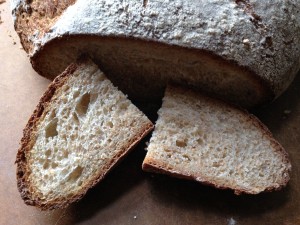
2014-09-08 18.11.11

Autumn cider loaf


Indian summer

After the dismal August, the weather has got all perky. As I write I’m considering putting my shades on just to see the laptop as sunlight streams in onto the kitchen table. Gertie kitten is sprawled out in front of me, between chest and keyboard, absorbing the rays. I love an Indian summer, it suits the English psyche. You get sunshine and a bit of warmth, but not too much, not enough to prevent the baking of bread or the eating of gravy.

The cold August / hot September is having repercussions though. Some of the tomatoes are rotting on the vine, I think killed off by the late summer chills. And news from the Shire tells me that the sloes are already going over – these that traditionally aren’t even picked until after the first frost! A Christmas of purple gin drinking is threatened.

I think the Shire is about a month ahead of Birmingham. I still have ripening borlotti beans and corns whilst my Mother’s been picking hers for about a month. Their spring started earlier of course, and most of the harvest is going over now. But not all.

2014-09-05 16.15.52

Mother’s epic peppers


Remember those sea-monster/crook neck squash we were offered the other week? Well, I took a look at the vine. This is a 12 foot wall. That is one epic plant.

2014-09-05 16.19.08

Squash plant / jungle monster

2014-09-05 16.18.23

Crook neck squash

2014-09-05 16.16.58

These are kinda fun

2014-09-05 16.21.34

The Viburnem in full glory


As ever, I’m sent home with a car full of food. Their tomatoes have already been roasted and sieved into passata, and the chillies will become sweet chilli sauce. But you know, the weekend’s picking from our allotment is pretty outstanding too. The raspberries just keep on coming. We’ve had the last of the beans now but the tomatoes are fat, soft and fragrant. Season’s pickings.

2014-09-05 17.55.35

Mother’s September harvest

2014-09-06 16.57.03

My September basket

Thoughts on bolognese

I made bolognese yesterday. I think for a lot of people this is an easy-peasy thirty-minute mince-and-tomato midweek supper. For a lot of other people – people like me – it is the source of debate and passion.

My mother’s bolognese recipe comes from a St Michael (that’s M&S in the old days) freezer cookbook, and uses tins of tomato puree liberally dressed with mushrooms. I’m not keen on mushrooms in bolognese and we’ve had a number of family rows about it. Why wreck a perfectly good dinner with fungi which, when cooked for an hour or so, resemble black slugs?

And then came along Matt, who threw out the spag bol rulebook by using – get this – CHUNKS OF BEEF rather than mince in his stew. This blew my mind. Not only were they chunks of beef, they were chunks of beef that he had hand-chopped to get the consistency that he wanted. I think it was this attention to detail that made me think he may be the chap for me, that plus the row of Elizabeth David cookbooks that I spied on his bookshelf on my first visit to his flat. Matt doesn’t understand spaghetti and so his bol is always served with a pasta tube of some sort. I think the Italians would approve of this.

(more…)

The last day of summer

It’s the last day of August today, which to me is the last day of summer. I spent three hours doing the jobs that I’ve been putting off for a few weeks whilst the weather has been so miserable – namely, weeding. Sodding weeds. They get everywhere. Fat hen, thistle, grass, butter-cup, loads more that I can’t identify…we have them all and they are virulent. The violas which I grew from seed back in March have come up, now exhausted after their long season of colour. And the foxgloves have gone in, to hopefully acclimatise for next summer.

The best solution for weeds is total ground cover – just starve them out. The squash are doing an excellent job of that, only 10 weeks old and already threatening to take over the entire neighbourhood. These are Turks Turban and I’m hoping that they get sufficiently gnarled and weird-looking in time for Halloween. There are 9 plants, and around 3 fruit per plant….that’s a lot of squash.

2014-08-31 14.34.12

Squash weed control

2014-08-31 14.34.22

Baby Turks Turban

Only one of the fennel seeds I planted a couple of weeks ago has made it up. I think it’s the bit of land they were planted on – we only had one successful carrot from that patch too. Not much you can do with only one carrot. However I think this little seedling needs saving and so it got its own little covering to stop it being gobbled by the pigeons.

Speaking of being cosseted, the greenhouse tomatoes are proving to be – if I’m honest – a bit of a disappointment. The fruits all seem to be ailed with one of four conditions:

2014-08-31 14.39.44

Issue 1: Blossom-end rot. I thought I’d got rid of all these but obviously not. You could stick your finger in this brown patch and it would come out covered in gunk.

2014-08-31 14.40.04

Issue 2: Scarring. I think this is due to the variety but not sure…it could just be another example of being High Maintenance.

2014-08-31 14.36.45

Issue 3: Splitting. Apparently this is something to do with heat and/or water. Also known as Definitely Being High Maintenance.

2014-08-31 14.37.32

Issue 4: Being gobbled by unknown creatures

I don’t think there’s much I can do now about the first three issues, but I can the last one. The creature in question left a trail of poo which led me to discover its identity (caterpillar) and hiding den (under a leaf). It got chucked onto next door’s strawberries (is that bad?) to survive another day in the Palace of Pigeons.

2014-08-31 14.40.28

Poo! On my tomatoes!

2014-08-31 14.43.04

The culprit. That’s a lot of poo for something so small.

But on the bright side, we’re not far off a hop harvest. Matt’s threatening to put these in the freezer (he’ll be lucky, there’s no room what with all the raspberries) but I think they’d make a good kitchen decoration. God only knows if they will actually ever get turned into beer.

2014-08-31 14.35.29

Flowers nearly at harvesting stage

2014-08-31 14.35.35

Challenger hop has nearly made it to the top of the hopolisk

Took up: violas, marigolds

Seedlings protected: fennel, cima di rapa, spring onions, chard, spinach

Planted out: foxgloves

Harvested: patty-pan, the Spring spring onions, tomatoes


Plum compote

On Wednesday I found myself at the side of an industrial building in the Shire, doing a deal. The substance in question was plums; the dealer was a dear old school friend Chappers. Chappers’ trademark is her Landie. You hear it before you see it. It suits her.

2014-08-27 13.26.11

Chappers handing over the goods


When the offer of a bag of free fruit comes along, you NEVER turn it down. These plums were pilfered by Chappers’ from her Mum’s orchard in Castlemorton, which by now will be laden with soft purple fruit. These home-grown plums are a bit different to the ones in the shops, much smaller, very difficult to stone, nectar-scented, and simultaneously sweet as you like whilst acidic enough to induce face-pulling. They would have been great for chutney, but really, who eats that much chutney? So compote it is.

2014-08-28 17.26.50

Coated in sugar

2014-08-28 17.39.57

Simmer down with a vanilla pod

I optimistically attempted to stone these before cooking, but gave up after about 5; it would have taken a whole day to stone the lot. So I just cooked them up and once cold, fished out the stones with my fingers. It came out quite tart so I put in more icing sugar at the end to balance the flavours. One carrier-bag of fruit produced about three pints of compote. It’s gloriously gloopy and unashamedly richly purple.

2014-08-29 13.55.12

Bagged up for freezing

There are endless possibilities for this…use as the base of a Bakewell tart, mix with custard for a fool, eat with yoghurt for breakfast, add cinnamon and five spice for a Chinese sauce, and so on.

I made trifle. Soak sponge with sherry, layer up with the compote, then top with home-made creamy vanilla custard and whipped cream. Any pudding that requires two different types (and cartons) of cream can’t be bad.

A question of squash

My folks came to visit yesterday. At this time of year that means a basket of goodies. I noted that the tomatoes, summer squash, courgette, corn, beans and chilli all hail from South America, looted by the Europeans and brought back to revolutionise our cooking. Centuries of history in one basket.

2014-08-25 14.54.56

Mother’s basket of goodies

The harvest gift is not just a kind gesture of course, it’s a way of off-loading stuff that they aren’t going to eat. But surely this must be the ultimate off-load: monumental crook-neck squash that had self-seeded and grown up the wall, and lost their crook to become almost as tall as me (almost).

2014-08-26 10.10.10

crookneck squash

If I were Indian or Malay or Mexican or some such, I am sure that squash would hold no fear. I am none of these things; a squash can sit unloved for months in my kitchen whilst I wonder what to do with it. Therefore the only thing for it is to get out the permanent marker and make… sea-monsters.

2014-08-26 10.10.37

Smile!

2014-08-25 18.01.03

Sea monsters at home on the veg rack

Endless amusement for months.

Cobnuts

There are certain fruits and veg which are foghorn signals of the season. For May there’s Evesham asparagus, for late January it’s Seville oranges. At this time of year, the hunt is on for the first cobnuts. On Thursday I found them in, of all places, Waitrose in Harborne, unceremoniously dumped underneath stray packets of chilli and coriander. I actually said out-loud “cobnuts!” and then remembered I was in public.

The shop assistant lugging around sacks of potatoes must have heard the exclamation for he sheepishly came up to me and, excusing his intrusion, asked what does one do with cobnuts. He said he’d been waiting for someone to pick them up so he could find out. I am SO his girl. For the next five minutes he got an impassioned monologue on all the brilliant things to do with cobnuts, how they can be used in salads and baking or just eaten raw with a beer, but how they are a total b*stard to peel.

Today Matt’s at work so am home alone. One thing for it: let’s attack these nuts.

2014-08-23 11.47.24

Essential cobnut kit

Conuts need two, sometimes three layers of peel removing. First take off the papery outer husk, then crack the shell to get to the kernel. Sounds easy (it is easy) but takes AGES.

2014-08-23 12.03.34

Naked nuts

2014-08-23 13.22.51

I had a helper

Then you get to the papery brown final layer. This has always confounded me – steam it off? Pick it off? This year I got luck as these were so fresh that most of them didn’t need the third peel. So three hours after starting, we get a bowl of nuts.

2014-08-23 14.45.38

The end product

Is it worth it? Well I think so, but I like meditative cooking. It’s not dissimilar from double-podding all those broad beans back in June; a way of feeling grounded and connected to the seasons.

These have now gone in the fridge but will be toasted in a dry pan and then used in a salad of dolcelatte and watercress with a mustardy dressing. Autumn is here.