Cottage Pie

We’ve had a disrupted week. Matt’s been doing 14-hour days again, building massive screens for a video art projection down in Birmingham’s Southside area. What this means in effect is that, for him, breakfast is coffee, lunch is something mayonnaise-y from Tesco and dinner is pizza from Dominoes. I have nobody to cook for and therefore live off pasta.

Meanwhile an old friend has received bad family-health-related news, the kind that made me catch my breath, count my blessings and make a quiet vow to be A Good Friend when called upon.

We need to find some comfort. I need to cook.

For years I’ve followed a brilliant blog Use Real Butter, created by Jen Yu, a photographer who lives near Boulder, Colorado, deep in the Rocky Mountains. This woman goes on trail runs before breakfast, coming across moose as a matter of course. I love it. Her last post saw her rustle up a Cottage Pie: just the business.

(more…)

Holiday crab linguine

To Lamorna, home of the Lamorna artists Laura and Harold Knight and AJ Munnings, and perhaps one of the more ruggedly evocative stretches of coastline in Cornwall.

Laura Knight is a personal art-hero. She was the first female artist to become a Royal Academician, the first to have her own exhibition at the RA, the only British artist to win official commissions as war artist in WW1 and WW2. I thought that she was the first woman to have a self-portrait at the National Portrait Gallery but I can’t verify that. She also spent her later years in Colwall so I like to think she was a fan of Malvern water. There is something so brilliantly bohemian about succeeding as a woman artist in the 1920s and 1930s, a time when female freedom was for most a dream rather than a reality.

It is easy to understand why artists congregated to Larmorna. This is a wild pre-historic landscape, set away from the rest of the world. Vast monoliths of rock seem to be carved with ancient faces, and the bracken appeared burnished against the October sun.

1058

Outstanding rocks

1054

Looking out to sea


P1030048

Autumn hedgerow

Food Bingo update: Crab has been struck off the list. We took a wrong-turn around Newlyn and ended up at the quayside, where you can still buy slabs of fish pretty much directly off the boat. Having grown up in land-locked Tamworth Matt is an expert crab picker (really) so chose the biggest, ugliest one to take home.

P1030053

£6.50 of fresh crab


Meanwhile I regaled stories of the 1896 Newlyn Fish Riot, in which the local fishing population were so outraged by outsiders (i.e. the non-Cornish) taking their boats out on Sunday, the day of rest, that a full blown riot ensued. They are God-fearing people around these parts – plus fish landed on the Sabbath reached a better price at market. Fishing boats were seized, 100,000 mackerel chucked overboard and the fish wives beat the interlopers up with haddock. (I may have embellished the last point, but the fish wives were definitely involved.) Which begs the question, is it better to be bashed with a stiff fresh haddock, or a floppy stinky one?

For dinner, holiday crab linguine, for two:

In a large pan, sweat a fat clove of garlic and finely chopped red chilli, to taste, in olive oil and butter.

Add one large chopped tomato and a good dollop of brown and white crabmeat and heat through – the intention is to warm rather than cook. Squeeze in lemon juice and season.

Pile cooked linguine on top and fork through the crab mixture, alongside a good handful of chopped herbs (parsley, Greek basil) and check the seasoning. You might need an extra glug of pasta water to get everything sticking together.

Serve. No parmesan needed.

Sweet chilli sauce

I’ve had to use up all those chillies from Mother’s greenhouse – 32, to be precise. Sweet chilli sauce it is.

2014-09-12 18.38.34

32 chillies waiting to be cooked up


I use a recipe from a great little paperback, Thai Cookery Secrets by Kris Dhillon. There’s no pictures, no styling, just clear instructions for all things Thai. I’ve altered the quantities in order to deal with the chilli glut and also added a little thickener, and so we need (original recipe in brackets):

32 (6) red chillies, green tops removed

40 (8) cloves of garlic, peeled

750ml (250ml) white vinegar (I use a mixture of white wine and rice, but only because that’s what I had)

750ml (250ml)  granulated sugar

1tbsp cornflour, slaked with a little water

5 (1) tbsp fresh lime juice

5 (1) tbsp fish sauce

Once you’ve gone through the lengthy steps of prepping all the chilli and garlic, put them in the food processor and whizz until finely chopped. Then simply pop it into quite a large pan along with the sugar and vinegar. It will look like this:

2014-09-12 19.18.54

Before cooking


Stir on a gentle heat until the sugar is dissolved, then put up the temperature and cook until syrupy. How long this takes depends on the quantities involved, but this vat took about 40 minutes (I cooked mine until the sugar thermometer read 110 celsius). Whatever you do, do not make the mistake of breathing in the chilli-vinegar fumes that will come off your saucepan, as you may never recover. I never, ever learn this lesson. You might want to open some windows and get the extractor fan on.

When it’s nearly ready, add a little of the slaked cornflour and cook it through until you have the consistency that you’re after – I tested by popping a little onto a saucer and leaving to cool a little. You want something that is still liquid but with some viscosity, like runny honey. When it’s done, take the pan off the heat.

I bottled this lot, leaving it to cool for half an hour and then pouring into sterilised jars. The sauce keeps pretty well but it’s best to leave it for a week or so before eating, to allow the vinegar to mellow.

2014-09-13 10.07.32

Sweet chilli sauce


An autumn loaf

Gertie has changed from a tiny ball of fluff into a slightly bigger ball of badness. Today she discovered the dustpan and brush, which as it turns out is the perfect size for a mid-morning kitten nap. Who knew?

2014-09-08 10.59.17

Last week I did one of those soul-destroying visits to Morrisons, the kind that make you grateful that you don’t go every week (one major bonus of having an allotment). It is quite incredible that some of the finest brains in retail have produced a shopping experience that is so uniquely energy sapping. Yet in their defence, on that visit they came up trumps: fresh yeast, hidden next to the butter, at the bargain price of 50p for 200g. That’s about enough for, what, 10 loaves? Best get baking.

2014-09-08 09.35.31

Fresh yeast

Fresh yeast is by FAR the best stuff for bread. The dried stuff is all very clean and efficient but always ends up tasting, well, yeasty. Fresh yeast is a different beast altogether, with a complex depth of flavour. It’s also easy as pie to use. None of that messing around with sugar and water and waiting for it to froth…just crumble it in the flour and you’re good to go.

It’s autumn so I thought I’d make a cider loaf (autumn…orchards…apples) but no cider in the house. What we do have is apple juice and lots of it, from Clives Fruit Farm in the Shire (Upton on Severn), squeezed from their own apples. This is a single variety Cox juice. Cider, apple juice, it’s all pretty much the same. I’d go for one that is dry-ish.

2014-09-08 09.36.35

Single variety apple juice from Clives, Upton on Severn

Cider wholemeal loaf:

250g strong wholemeal flour

250g strong white flour

10g fine sea salt

150ml milk

250ml dry cider or apple juice

25g fresh yeast

This is a recipe I’ve adapted from Nigel Slater’s Kitchen Diaries (he uses spelt flour and honey).

Put the salt at the bottom of a large bowl and add your flour on top – combine to mix. By doing this there is no chance of your salt killing the yeast. Next rub the yeast into the flour, just as if making a crumble.

Warm up the milk until when you put your finger in it, it feels neither warm nor cold, just wet. Good bit of advice that. Slosh it in, and then add the cider/juice. I do it in this order as if you mix the liquids in the jug the cider makes the milk separate into a claggy mess.

2014-09-08 09.39.23

Slosh it all in

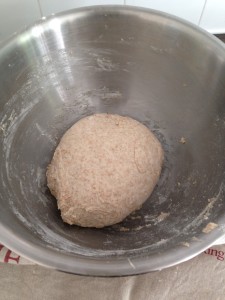
Mix together with a scraper and then tip out onto your work surface and knead. I use the Bertinet technique (google: Richard Bertinet) which I won’t repeat here, only to say that it will make you a good baker of bread. After a few minutes you will go from having a wet mass of stodge into a springy bouncy ball of dough. Shape it into a round and place it back in your mixing bowl.
2014-09-08 09.48.16

Kneaded!


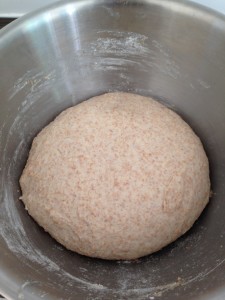
Place a cloth on the bowl and leave for about an hour or until roughly doubled in size. The milk and cider means that it may take longer to rise. That’s OK, just be patient.
2014-09-08 10.58.28

Risen!


I like this bread shaped into a round, so I use a proving basket for the second rise. Turn out your dough onto a lightly floured work surface, shape it, and then place presentation-side-up down in the basket. Dough has to be properly shaped with a ‘backbone’ to give it the structure it needs to rise properly. Just google Bertinet, he’ll tell you everything you need to know.

Leave again, this time for about 45 minutes. Meanwhile heat the oven as high as it will go – 220c or higher – and place a baking sheet in there to warm up.

2014-09-08 11.46.20

After the second rise


To bake, have ready some baking parchment on top of a lightweight flat board, pizza peel or suchlike. Turn out the dough onto the paper and slash the top (I use a razor blade). A lot of bakers don’t use paper but it’s so much easier to manage if you do. Then slide the loaf and paper onto your heated baking sheet, directly into the oven. Bake for 10 minutes or so at the highest temperature, then turn down to 190c and finish the bake. This one took 40 minutes in total.

2014-09-08 12.43.25

The finished article

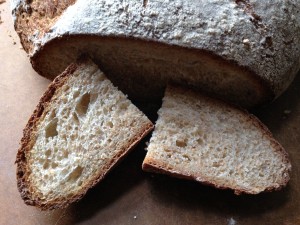
I think this loaf is actually a little over-proved, which you can tell from the way the slashes have (or haven’t) opened. No matter, it still tastes good. It’s isn’t apply, just…earthy. This loaf will keep for a good couple of days and is fine for toast after.
2014-09-08 18.11.11

Autumn cider loaf


Thoughts on bolognese

I made bolognese yesterday. I think for a lot of people this is an easy-peasy thirty-minute mince-and-tomato midweek supper. For a lot of other people – people like me – it is the source of debate and passion.

My mother’s bolognese recipe comes from a St Michael (that’s M&S in the old days) freezer cookbook, and uses tins of tomato puree liberally dressed with mushrooms. I’m not keen on mushrooms in bolognese and we’ve had a number of family rows about it. Why wreck a perfectly good dinner with fungi which, when cooked for an hour or so, resemble black slugs?

And then came along Matt, who threw out the spag bol rulebook by using – get this – CHUNKS OF BEEF rather than mince in his stew. This blew my mind. Not only were they chunks of beef, they were chunks of beef that he had hand-chopped to get the consistency that he wanted. I think it was this attention to detail that made me think he may be the chap for me, that plus the row of Elizabeth David cookbooks that I spied on his bookshelf on my first visit to his flat. Matt doesn’t understand spaghetti and so his bol is always served with a pasta tube of some sort. I think the Italians would approve of this.

(more…)

Cobnuts

There are certain fruits and veg which are foghorn signals of the season. For May there’s Evesham asparagus, for late January it’s Seville oranges. At this time of year, the hunt is on for the first cobnuts. On Thursday I found them in, of all places, Waitrose in Harborne, unceremoniously dumped underneath stray packets of chilli and coriander. I actually said out-loud “cobnuts!” and then remembered I was in public.

The shop assistant lugging around sacks of potatoes must have heard the exclamation for he sheepishly came up to me and, excusing his intrusion, asked what does one do with cobnuts. He said he’d been waiting for someone to pick them up so he could find out. I am SO his girl. For the next five minutes he got an impassioned monologue on all the brilliant things to do with cobnuts, how they can be used in salads and baking or just eaten raw with a beer, but how they are a total b*stard to peel.

Today Matt’s at work so am home alone. One thing for it: let’s attack these nuts.

2014-08-23 11.47.24

Essential cobnut kit

Conuts need two, sometimes three layers of peel removing. First take off the papery outer husk, then crack the shell to get to the kernel. Sounds easy (it is easy) but takes AGES.

2014-08-23 12.03.34

Naked nuts

2014-08-23 13.22.51

I had a helper

Then you get to the papery brown final layer. This has always confounded me – steam it off? Pick it off? This year I got luck as these were so fresh that most of them didn’t need the third peel. So three hours after starting, we get a bowl of nuts.

2014-08-23 14.45.38

The end product

Is it worth it? Well I think so, but I like meditative cooking. It’s not dissimilar from double-podding all those broad beans back in June; a way of feeling grounded and connected to the seasons.

These have now gone in the fridge but will be toasted in a dry pan and then used in a salad of dolcelatte and watercress with a mustardy dressing. Autumn is here.

Passata

On Saturday my folks turned up with a box of tomatoes, about 15 black peppers (more on those another day), a strimmer, and plenty of jibes about general laziness in the allotment. The jibes stopped when they went down there and saw the general epic-ness that is now our veg patch. The cosmos are better than my mother’s! Though I am still looking after my tomatoes incorrectly (they need thinning) and must get rid of the perennial weeds (*cough* fat chance). I should add here my mother is to gardening what Mary Berry is to cherry cake.

Whilst Dad wandered off to talk Worcestershire to unsuspecting Brummies, I wondered what to do with those tomatoes. To me, the tomato glut marks the turn from summer to autumn. It’s time to get preserving. Which means one thing: passata.

Same technique as every year: slice in half around their equators, roast for about an hour, push through a sieve, and that’s it. I freeze mine ready for chillies, bolognese, ragu, stews, and so on.

P1020991

About half of what I was given. Each of these is the size of a navel orange.

P1020993

Halved, drizzled with oil, ready for roasting.

P1020995

An hour and a bit later…

P1020997

An hour or so later – passata!


This year’s passata is great stuff – rich and thick, not too watery.

Speaking of autumn, last night’s dinner was short beef rib braised in red wine and herbs, served with roasted new potatoes, roasted onions and allotment veg (greens, beans etc). To follow, damson crumble. What could be more autumnal than that?

This evening I dutifully thinned out the Grange Hill tomatoes, did another harvest of beans, Eton tomatoes and lettuce. Pulled out the last of the summer lettuce, now crisp from heat. Had to hack off a sunflower head that had been strangled by the straggling borlotti shoots, as together they were making a wind barrier that was threatening to bring the whole lot down. Then dodging a torrential downpour, started off the autumn lettuce ready for planting out in a few weeks time.

Yotam’s noodles

A quick Monday night supper that is unexpectedly good. Credit Yotam Ottolenghi.

Cook thick wheat noodles in the usual way.

Fry off ginger and garlic in the wok, add fingers of kohl rabi, spring onion and green beans – any crunchy veg would do. Add in chard stalks and leftover chicken. Tofu would also work well here.

Add half teaspoon cumin, same ground coriander, two teaspoons each soy, kecap manis, chilli sauce and a squeeze of lime.

Add chard or spinach and wilt with splash water. Add noodles back to pan and toss through.

Served with chopped coriander and toasted peanuts. Rich, sweet, hot, salty and satisfying.

To finish – gooseberry crumble and cream (me) and stolen blackcurrant ice (him).

Artichokes, part 2

Part 2 is significantly easier than part one.

To recap – the hearts were simmered in vinegar, white wine and salt, then left wrapped in a tea towel in the fridge for 36 hours.

I prepped the kilner jars by boiling in water for about 15 minutes, then swilling with fresh lemon juice to kill any remaining bugs.

The hearts were then layered in with whole garlic cloves, dried chili and bay, then topped with mild olive oil. Leave for a few weeks to mellow.

P1020988

Jarred artichokes

Artichokes, Part 1

Attempting to preserve and bottle the artichokes, all 27 of them. Transpires that we have the wrong kind of choke – ours are globe, fat and hairy, when what we need are the small Italian purple ones. We carry on regardless.

Trim the lot down to hearts alone, all full of choke – probably actually should have harvested a couple of weeks ago. First ones go too far, leaving just the hearts, but second batch I leave a few of the leaves on and they are no worse for it.

Leave in lemon water and scrape several times with spoon to get rid of the browning. These are spiny buggers – fingers covered with hairy needles – and HOW much waste? Are they ever worth it? Takes a few hours to prep them all.

Simmer the hearts in equal parts white wine and white wine vinegar, plus salt, then leave wrapped in a cloth in the fridge for another day. We shall see.

Artichoke prep

Artichoke prep

P1020983

Cooking them up

Dinner – Chicken roasted with fennel and Mother’s carrots, new potatoes and bobby beans, followed by gooseberry crumble.